What Size Solar System Do I Need?
Turn your daily energy use into panel watts, battery size and a charge controller that suits them.
There's no single right size. A solar system is sized from three things: how much energy you use in a day, how much sun you get in the worst season you need it to work, and how long you want to keep going when the sun doesn't show up. This guide walks through each one, then puts them together in one worked example.
1. Start with your daily energy
Everything else depends on this number. It's the energy, in watt-hours (Wh) or kilowatt-hours (kWh), that your system has to supply on a normal day.
- Watts (W) are how hard something draws power while it's running.
- Watt-hours (Wh) are the energy it uses over time: watts × hours. 1,000Wh is 1kWh, the same unit as on your power bill.
If you haven't worked it out yet, start with How to Calculate Your Home or Workshop Power Needs, or use the Daily Power Needs Calculator. Both add a margin for losses in the inverter, the battery charging and the wiring.
2. How much will your panels make?
A panel's watt rating is what it makes in ideal test conditions. Over a real day, what matters is peak sun hours: the day's sunshine expressed as hours of full-strength sun. A winter day with 3 peak sun hours delivers the same energy as 3 hours of full sun, even though it's light for much longer than that.
Real panels also lose output to heat, dust, the angle they face, shade, and losses in the controller, battery and cables. Allow for that with a loss allowance.
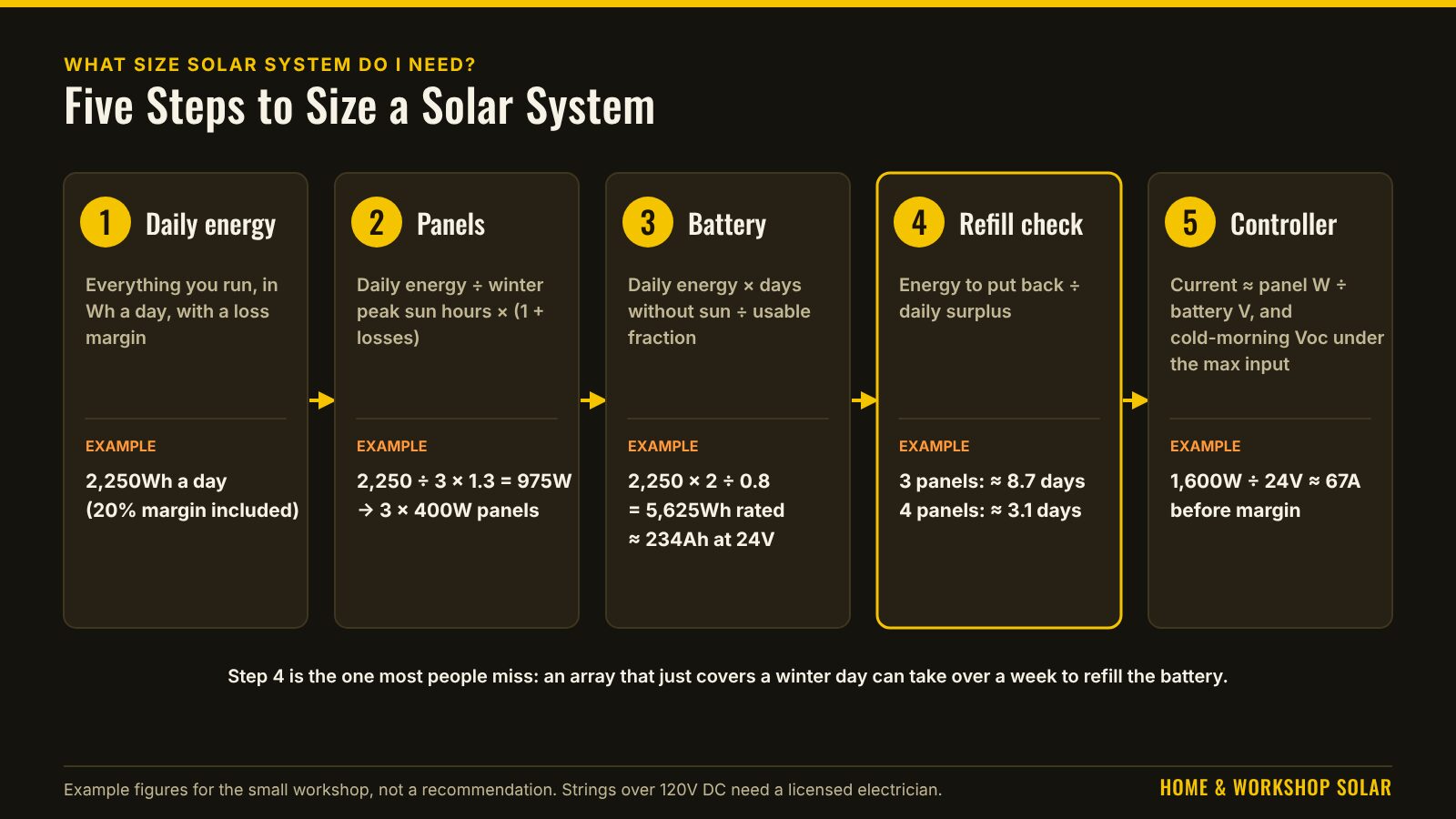
Panel watts needed ≈ daily energy ÷ peak sun hours × (1 + loss allowance)
Two points matter most:
- Use a winter figure if the system has to work all year. Peak sun hours in winter can be far lower than in summer. The Bureau of Meteorology publishes solar exposure data, and a local installer will know your area.
- Shade matters more than you'd expect. Shade on even part of a panel can cut its output a lot.
The Solar Array Size Calculator does this sum and tells you how many panels of your chosen size it takes.
3. Battery: covering nights and cloudy days
Solar only arrives in daylight. Your battery carries you through every night, and through runs of cloudy days.
Usable battery energy needed ≈ daily energy × days you want to run without sun
Not all of a battery's rated capacity is usable. The maker says how deeply it can be discharged, and that differs between chemistries and models. Divide by the usable fraction from the battery's specification to get the rated capacity:
Rated battery energy ≈ usable energy needed ÷ usable fraction
To turn watt-hours into amp-hours, divide by the system voltage. If you haven't chosen one yet, see 12V, 24V or 48V? Picking Your System Voltage.
More days of autonomy means a bigger, dearer battery. It also means more panels to fill it again, which is the next step.
4. Recharging after cloudy days: the step most people miss
An array sized to cover exactly one day's use on a winter day will keep up on sunny days. It won't refill a battery you've drained over a few cloudy days. Only the energy left over after the day's use goes back into the battery.
Days to refill ≈ energy to put back ÷ (daily solar output − daily use)
If that surplus is small, recovery takes a long time. Another run of cloud before you've caught up can leave you flat. Your options are:
- More panels. This is often the cheapest way to recover faster.
- A backup charging source, such as a generator or a grid-powered charger, used through a suitable inverter-charger or battery charger.
- Cutting back on the heavy loads until the battery recovers.
Charging also slows as a battery nears full, and the charger and battery both have current limits. Real recovery is usually a little slower than the sum suggests.
5. Charge controller limits
The charge controller sits between the panels and the battery. It has to suit both, and it has two separate limits:
- Current to the battery: roughly the panel watts ÷ battery voltage, plus a margin. The same panels on a higher-voltage battery need fewer amps.
- Voltage from the panels: panels wired in series add their voltages together. The total open-circuit voltage (Voc) must stay below the controller's maximum input voltage, even on a cold morning, when panel voltage rises. Going over it can destroy the controller.
Also check that the controller has a charging profile for your battery chemistry, and look at its maximum panel short-circuit current. The MPPT Controller Size Calculator checks both limits from your panel's label figures. PWM vs MPPT Charge Controllers explains which type suits you.
A panel string over 120V DC is no longer extra-low voltage and can give a dangerous shock. That wiring must be done by a licensed electrician.
6. Worked example: a small workshop
This example continues the workshop from How to Calculate Your Home or Workshop Power Needs. Every figure is an example assumption, not a recommendation for your site or for any product.
Assumptions
| Item | Assumed figure | Where it comes from |
|---|---|---|
| Daily energy | 2,250Wh (2.25kWh) a day, with the 20% loss margin already included | The power-needs guide's example |
| Peak load | 1,950W | The power-needs guide's example |
| Winter peak sun hours | 3 | Example only; check your own area |
| Loss allowance for the panels | 30% | Example; the Solar Array Size Calculator's starting value |
| Panel size | 400W | Example panel rating |
| Days without sun | 2 | Example choice |
| Usable fraction of the battery | 80% | Example only; use the battery maker's figure |
| System voltage | 24V | The system voltage guide suggests 24V for a 1,500 to 3,000W peak load |
Step A: panels to cover a winter day
2,250 ÷ 3 = 750W before losses. With the loss allowance: 750 × 1.3 = 975W.
With 400W panels, that is 975 ÷ 400 = 2.4, so round up to 3 panels (1,200W). On an example winter day those make about 1,200 × 3 ÷ 1.3 ≈ 2,770Wh.
Step B: battery for two days without sun
2,250 × 2 = 4,500Wh usable. At 80% usable, the rated battery energy is 4,500 ÷ 0.8 = 5,625Wh. At 24V that's 5,625 ÷ 24 ≈ 234Ah. Real batteries come in set sizes, so you'd look at the nearest sizes from the maker and check their usable figure.
Step C: can the panels refill the battery?
After two flat days, there's 4,500Wh to put back.
| Panels | Winter output | Surplus after the day's use | Days to refill 4,500Wh |
|---|---|---|---|
| 3 × 400W (1,200W) | ≈ 2,770Wh | ≈ 520Wh | ≈ 8.7 days |
| 4 × 400W (1,600W) | ≈ 3,690Wh | ≈ 1,440Wh | ≈ 3.1 days |
Three panels cover a winter day, but they'd take more than a week of clear winter sun to catch up after two cloudy days. A fourth panel cuts that to about three days. Alternatively, keep three panels and plan on a generator or grid charger for recovery.
Step D: charge controller current
With 1,600W of panels on a 24V battery: 1,600 ÷ 24 ≈ 67A, before any margin. On a 12V battery, the same panels would need about 133A, which is one reason bigger systems move up in voltage. Look for a controller, or controllers, rated above your figure with your chosen margin, per the maker's sizing guidance.
Step E: charge controller voltage
This depends on your actual panels and how many you wire in series. Enter the Voc, Vmp and Isc from the panel label, your coldest expected morning and the series and parallel layout into the MPPT Controller Size Calculator. Then compare the result with the controller's maximum input voltage. We haven't given figures here because they depend entirely on the panel model.
What the example shows: for this workshop's winter use, a sensible starting point to price up and check would be about 1,200 to 1,600W of panels, around 5.6kWh of rated battery at 24V and an MPPT controller sized for the final array. The fourth panel is the difference between recovering in three days or more than a week. Your own numbers will differ, sometimes a lot.
7. Before you buy
- Use your own daily energy figure. Measure where you can.
- Use winter sun hours for your area, and think honestly about shade.
- Decide how many cloudy days you need to cover, and how you'll recover after them.
- Check every part against its manual: battery usable capacity and charge limits, controller current and voltage limits, inverter continuous and surge ratings.
- Take the plan to a qualified installer for the design and installation.
These are planning estimates. Real results depend on your location, weather, shading and the gear you choose.
Safety: in Australia, any work on 240V AC wiring, including connecting an inverter, battery or solar system to a home's switchboard or fixed wiring, must be done by a licensed electrician. Grid-connected systems also need approval from your electricity network. Panel strings over 120V DC must also be wired by a licensed electrician.
Related guides: How to Calculate Your Home or Workshop Power Needs · 12V, 24V or 48V? Picking Your System Voltage · PWM vs MPPT Charge Controllers
Related guides
How to Calculate Your Home or Workshop Power Needs
The first step for any solar system: list what you run, how long for, and turn it into the daily energy your system has to supply.
Read guide →
12V, 24V or 48V? Picking Your System Voltage
Why system voltage matters, how it changes the current and cable size, and which voltage suits a shed, workshop or home.
Read guide →