How to Choose an Off-Grid Inverter
Size it, match it to your battery, and decide whether you need an inverter-charger.
The inverter turns your battery's DC power into 240V AC for normal appliances and tools. In an off-grid system it does more than that. It often charges the battery from a generator, talks to the battery, and decides what happens when power runs short. Choosing the right one means looking past the headline watts.
1. Size: continuous and surge
Two ratings matter:
- Continuous rating: the power it can supply all day. Size it above the total of everything you'll run at once, with some headroom.
- Surge rating: the short burst it can supply when a motor starts. It must cover your hardest-starting tool or appliance on top of everything else running. Check how long the surge lasts, because makers measure it differently.
Work both out with the Inverter Size Calculator, and see Running Power Tools Off Solar for motor surges.
Example (from our workshop example): a 1,950W peak load suits an inverter of about 2,500 to 3,000W continuous, with a surge rating that covers the drop saw starting.
1a. Surge worked example: the workshop
Motors often draw two to three times their running watts for a moment when they start. Example figures:
- The drop saw runs at 1,800W, so its start-up surge might be about 3,600 to 5,400W.
- Lights, fridge and radio are already running (about 150W).
- Surge needed: about 3,750 to 5,550W, for a moment.
- Continuous needed: above 1,950W, so a 2,500 to 3,000W inverter.
Check both numbers against the inverter's data sheet, including how long its surge rating lasts. If the surge is marginal, start the saw before switching on other loads, or choose a larger inverter.
1b. A small example: the 12V shed
A hobby shed with LED lights, a radio, a tool battery charger and a laptop has a peak of about 190W and no motors.
- With some headroom, a 300 to 500W pure sine inverter is plenty. A bigger one adds cost and idle draw for no benefit.
- Battery current at the 190W peak: 190 ÷ 0.9 ÷ 12 ≈ 18A.
- Many of these loads can run on 12V DC directly, with no inverter at all.
2. Pure sine only
For an off-grid shed, workshop or home, buy pure sine. See Pure Sine vs Modified Sine Inverters.
3. Battery voltage
The inverter's DC input must match your battery system voltage: 12V, 24V or 48V. Bigger inverters are usually built for 24V or 48V, because the battery current at 12V gets very high. See 12V, 24V or 48V? Picking Your System Voltage.
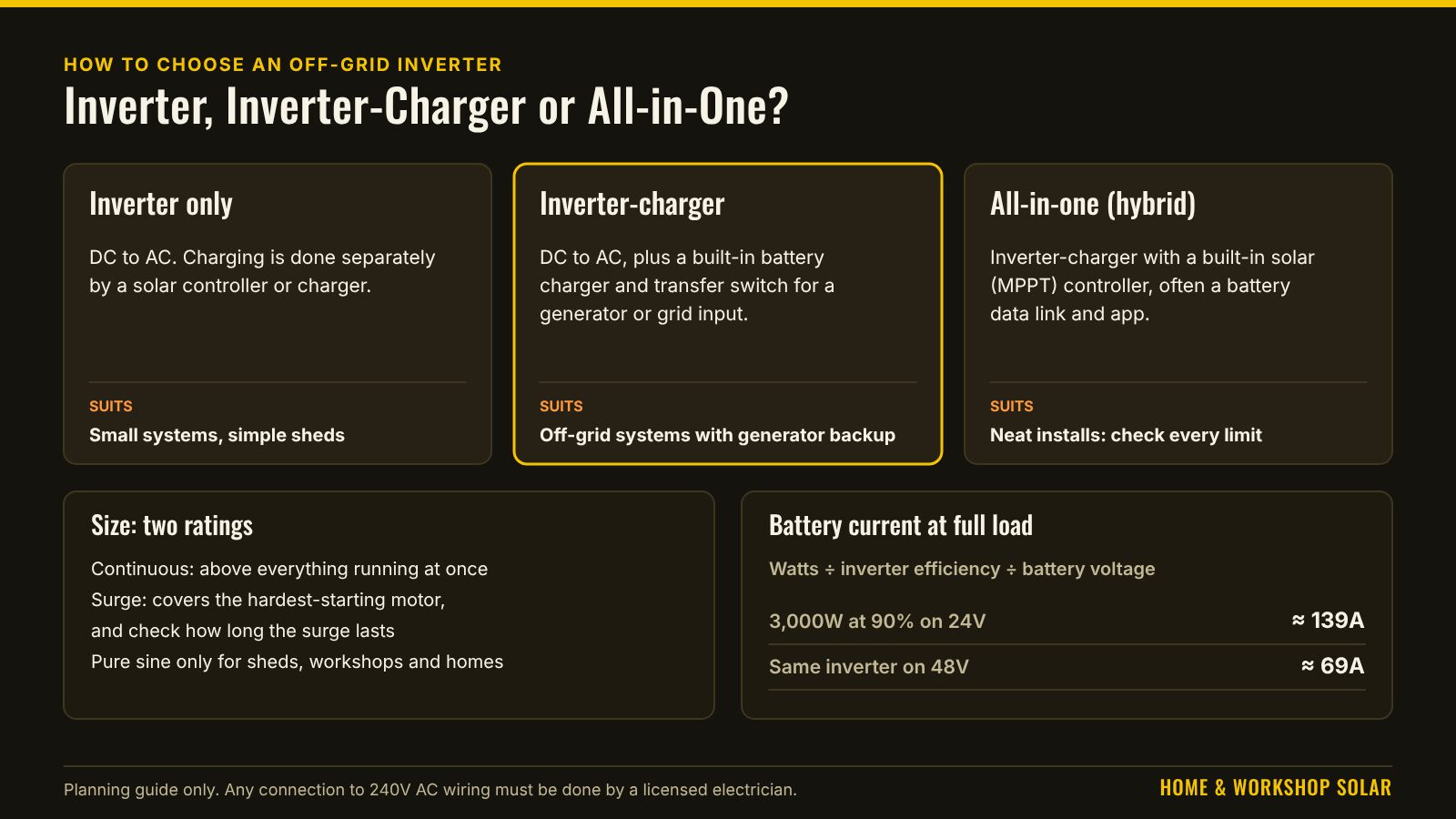
Battery current at full load ≈ watts ÷ inverter efficiency ÷ battery voltage.
Example: 3,000W at 90% efficiency (example) on 24V: 3,000 ÷ 0.9 ÷ 24 ≈ 139A. On 48V it's about 69A. The battery's continuous discharge rating must cover this.
4. Inverter, inverter-charger or all-in-one?
| Type | What it does | Suits |
|---|---|---|
| Inverter only | DC to AC. Charging is done separately (solar controller, separate charger) | Small systems; simple sheds |
| Inverter-charger | DC to AC, plus a built-in battery charger and transfer switch for a generator or grid input | Most off-grid systems with generator backup |
| All-in-one (hybrid) unit | Inverter-charger with a built-in solar (MPPT) controller, and often a battery data link and app | Neat installs; check every limit carefully |
Inverter-charger features worth checking:
- Generator input and an AC input current limit, so it doesn't overload a generator. See Generator Backup for an Off-Grid Solar System.
- Charger current, and a charging profile for your battery chemistry.
- Transfer time: how fast it switches between generator and inverter.
- Generator auto-start, if you want it.
All-in-one units: check the built-in solar controller's maximum PV voltage, current and power, just as you would a separate controller. See the MPPT Controller Size Calculator.
5. Idle draw
Inverters use power just being switched on, and a big off-grid inverter's idle draw adds up over 24 hours. Check the no-load or idle power in the specification, and whether it has a power-saving or search mode. Add it to your daily energy.
5a. Idle draw matters most in small systems
Example figures:
- Workshop: a 20W idle draw left on all day uses 480Wh, about a fifth of the workshop's 2,250Wh a day.
- Shed: an 8W idle draw uses 192Wh, about half of the shed's 400Wh a day.
The smaller the system, the more the inverter's own draw matters. Choose an inverter that isn't oversized, use its power-saving or search mode if it has one, and switch it off when you don't need 240V AC.
6. Battery compatibility
- Chemistry: the charger must support your battery's chemistry and the battery maker's charge settings.
- Communication: many lithium batteries talk to the inverter over a data link. Check the battery is on the inverter maker's compatibility list, or the other way round.
- Battery current limits: the battery must handle the inverter's full-load current and its charge current.
7. Approvals, compliance and warranty
- Buy for the Australian market: Australian outlets, compliance markings and local support.
- If it will ever connect to a building's wiring or the grid, it must be suitable for that use and installed by a licensed electrician. Grid-connected inverters also need approval from your electricity network, and must be on the approved list for grid connection.
- Warranty: check the length, the conditions (approved installer, compatible battery, operating temperature) and who honours it in Australia.
8. Before you buy: checklist
- ☐ Continuous rating above everything running at once, with headroom
- ☐ Surge rating (and duration) covers the hardest-starting motor
- ☐ Pure sine
- ☐ DC input matches your battery voltage
- ☐ Battery can supply the full-load current
- ☐ Charger, generator input and AC input limit suit your backup plan
- ☐ Built-in solar controller limits suit your panels (all-in-one units)
- ☐ Idle draw added to your daily energy
- ☐ Battery chemistry, settings and communication are compatible
- ☐ Australian compliance, approvals and warranty checked
- ☐ Installation by a licensed electrician for any 240V AC wiring
8a. Settings to check at installation
Your installer sets these, but it helps to know what to ask about:
- Battery type and charge settings match the battery maker's figures.
- Low-battery cut-off suits the battery, so the inverter stops before the battery's own protection has to.
- AC input current limit suits the generator.
- Generator auto-start, if fitted: the start and stop conditions.
- Power-saving or search mode, if used: which loads still wake it.
- Battery communication, if the battery has a data link.
9. Inverter problems that trace back to the choice
| What happens | Likely cause | What it points to |
|---|---|---|
| Shuts down when the saw or compressor starts | Surge rating too low, or the battery current limit was hit | Check the surge rating and its duration, and the battery's discharge limit |
| Low-battery alarm under heavy load, though the battery isn't flat | Voltage sags under high current, typical at 12V with big loads | System voltage too low for the load |
| Battery drains overnight with nothing on | Idle draw | Oversized inverter, or power-saving mode not used |
| Won't accept the generator | Generator voltage, frequency or waveform outside the input limits | Generator and inverter-charger compatibility |
| Generator stalls when charging starts | Charger plus loads exceed the generator's continuous rating | AC input current limit setting |
| Motors hum or run hot; some chargers fail | Modified sine output | A pure sine inverter is needed |
Diagnosing faults in an installed system, and anything on the 240V AC side, is a job for the installer or a licensed electrician.
10. Common mistakes
- Sizing to running watts and forgetting surge.
- A big 12V inverter where 24V or 48V would halve or quarter the current.
- Buying inverter-only, then wanting a generator.
- An oversized inverter in a small system, wasting energy on idle draw.
- Not checking battery compatibility and charge settings.
- Buying an inverter not intended for the Australian market, or for the way it will be connected.
11. Frequently asked questions
What size inverter do I need for power tools?
A continuous rating above everything that runs at once, and a surge rating that covers the biggest motor starting. Use the Inverter Size Calculator.
Is a modified sine inverter OK for a shed?
For an off-grid shed, workshop or home, choose pure sine. Some motors, chargers and electronics run poorly or hot on modified sine.
What's the difference between an inverter-charger and a hybrid inverter?
An inverter-charger adds a battery charger and a generator or grid input. A hybrid (all-in-one) unit also includes a solar charge controller. Names vary between makers, so check what the unit actually does.
Can I plug my inverter into a power point to power the house?
No. Connecting an inverter to a building's wiring must be done by a licensed electrician, with the correct equipment.
Does a bigger inverter use more power?
Usually it has a higher idle draw, so an oversized inverter wastes more energy each day. Size for your loads with sensible headroom.
These are planning estimates only, not a system design, wiring specification or safety assessment.
Safety: in Australia, any work on 240V AC wiring, including connecting an inverter, battery or solar system to a home's switchboard or fixed wiring, must be done by a licensed electrician. Grid-connected systems also need approval from your electricity network.
Handy gear
These are examples to compare, not a recommendation for your home. Check any model's data sheet against this guide.
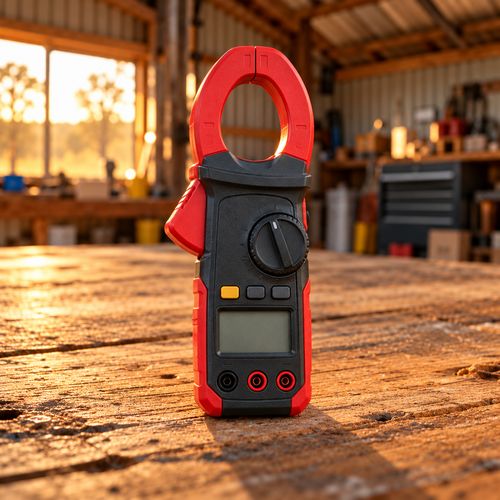
Clamp meter
Checks real loads and start-up surge without breaking the circuit.
Check Price on AmazonAs an Amazon Associate I earn from qualifying purchases. Prices and availability are shown on Amazon.
Related guides
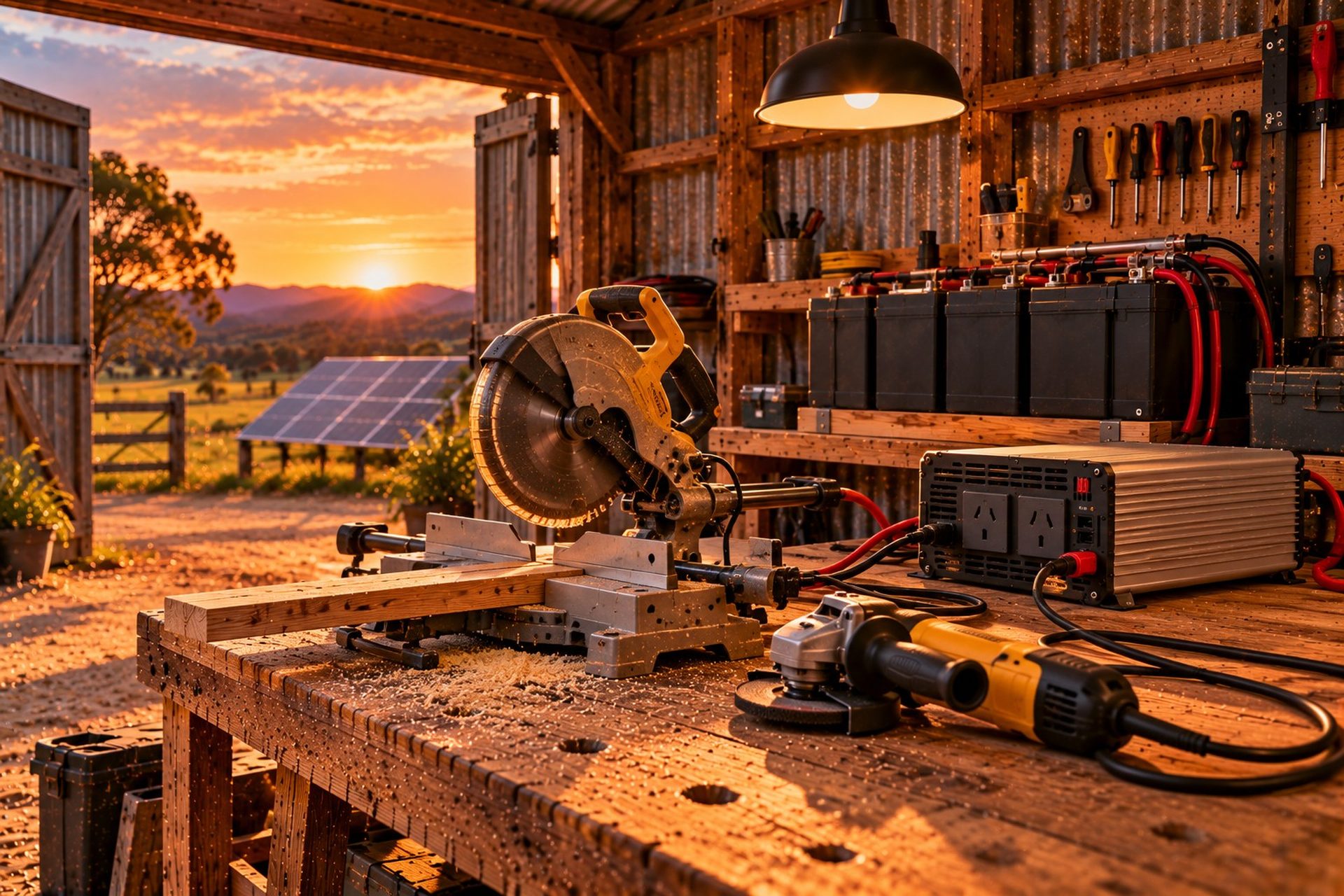
Running Power Tools Off Solar: Inverter Size and Surge
How much inverter and battery you need to run workshop tools, why motors need a surge allowance, and what runs easily.
Read guide →
Pure Sine vs Modified Sine Inverters
How the two types of inverter differ, which appliances and tools need pure sine, and what to check before you buy.
Read guide →