Generator Backup for an Off-Grid Solar System
When a generator earns its place in an off-grid system, and what has to match before you connect one.
Off-grid solar works well most of the year, but winter and long cloudy spells can leave the battery struggling. A backup generator fills the gap. Set up properly, it means you can size the solar and battery for normal conditions instead of the worst week of the year.
This guide explains when a generator is worth having, how it fits into the system, what size to consider and what has to be compatible. It doesn't explain how to wire one in. That's a job for a licensed electrician.
1. When a generator makes sense
- Winter shortfall: the panels can't keep up with your use in the shortest, cloudiest weeks.
- Long cloudy spells: the battery runs down over several days. See What Size Solar System Do I Need? for why panels sized for one day can't refill a drained battery quickly.
- Occasional heavy loads: a welder, big compressor or other tool that's beyond the inverter or battery.
- A smaller, cheaper system: a generator for the odd bad week can cost less than the extra panels and battery needed to cover it.
A generator is less useful if you hardly ever run short, or if noise and fuel are a problem where you live.
2. How it fits in
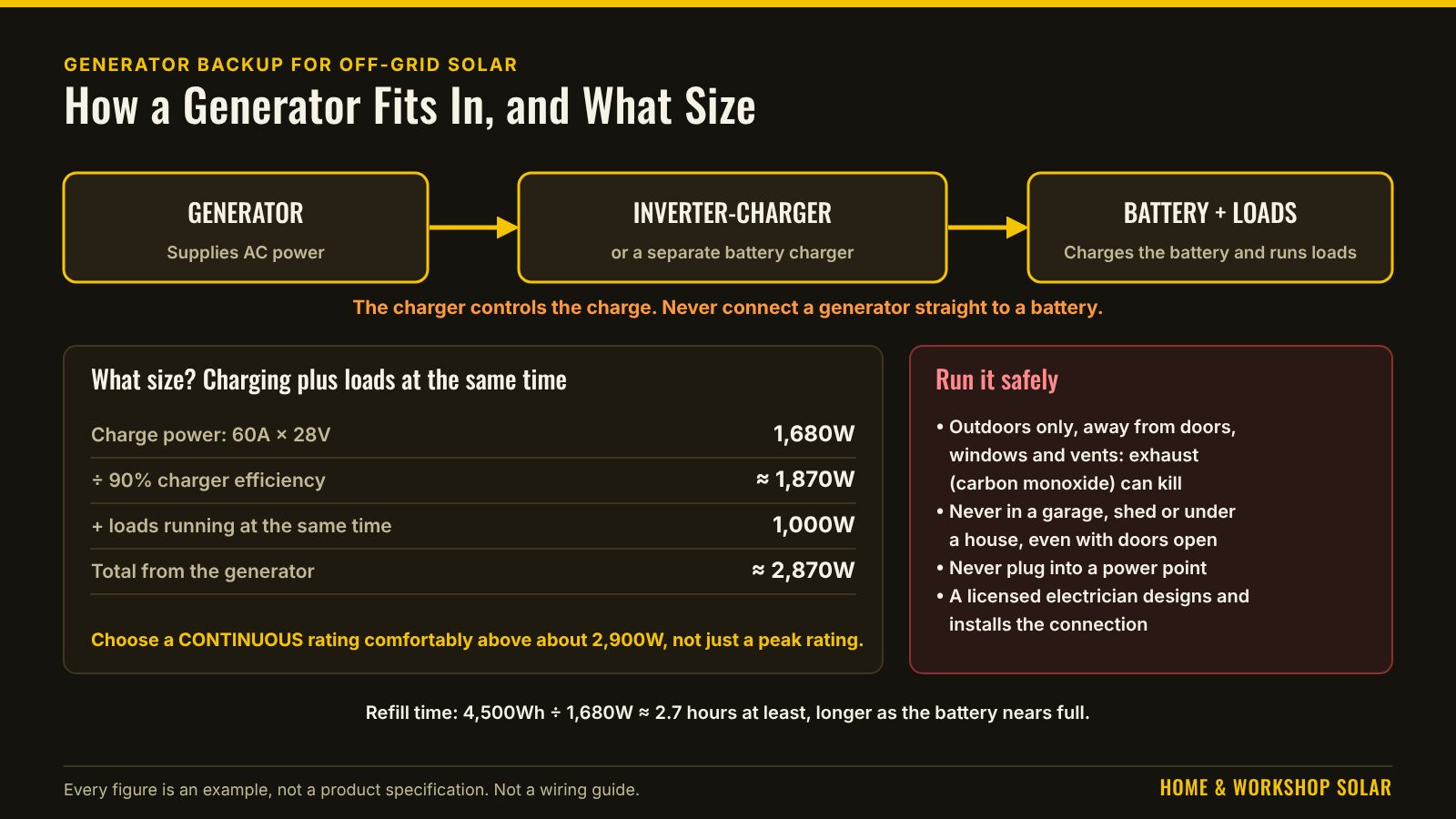
In most off-grid systems, the generator doesn't charge the battery directly. It supplies 240V AC power to either:
- an inverter-charger with a generator (AC) input. It passes power through to your loads and uses the rest to charge the battery, or
- a separate battery charger that suits the battery's chemistry and voltage.
The charger is what controls the charge. Never connect a generator to a battery without a suitable charger in between.
Wired For The Wild explains the same idea for 12V camping setups in How to Charge a 12V Battery From a Generator.
3. What size generator?
The generator has to cover two things at once:
- The charger's input power, and
- Any loads running through the inverter-charger while the generator is on.
Worked example (every figure is an example, not a product specification):
- A 24V inverter-charger set to charge at 60A. Battery charging voltage is about 28V, so the charge power is about 60 × 28 = 1,680W.
- Charger efficiency 90%: 1,680 ÷ 0.9 ≈ 1,870W from the generator for charging.
- Loads running at the same time: 1,000W.
- Total from the generator: 1,870 + 1,000 ≈ 2,870W.
So this setup would suit a generator with a continuous rating comfortably above about 2,900W, not just a peak rating.
Most inverter-chargers let you set an AC input current limit. It caps how much the inverter-charger draws from the generator, sharing it between charging and loads. For example, a 10A limit at 240V AC is about 2,400W. Setting the limit to suit the generator stops the generator being overloaded. Check your inverter-charger's manual.
Refill time: if the battery is down 4,500Wh, charging at 1,680W takes at least 4,500 ÷ 1,680 ≈ 2.7 hours, and longer in practice because charging slows as the battery nears full.
3a. A smaller generator: what the AC input limit does
Example figures: say you already own a generator rated 2,000W continuous.
- Set the inverter-charger's AC input limit to suit it: 2,000 ÷ 240 ≈ 8.3A, so a limit of about 8A, or 8 × 240 = 1,920W. Check the manual for how your model sets this.
- With 1,000W of loads running, about 1,920 − 1,000 = 920W is left for the charger.
- At 90% efficiency, about 830W reaches the battery, or roughly 830 ÷ 28 ≈ 30A at 24V.
- Refilling 4,500Wh now takes at least 4,500 ÷ 830 ≈ 5.4 hours, instead of 2.7.
A smaller generator still works. It just runs longer. Switching big loads off while it charges shortens the run.
3b. Generator or more panels?
| A generator | More panels | |
|---|---|---|
| Covers | Long cloudy spells, heavy one-off loads | Everyday winter shortfall; faster refill on sunny days |
| Running cost | Fuel and servicing | Very little |
| Noise and fumes | Yes | No |
| Works with no sun | Yes | No |
| Best when | Shortfalls are rare but serious | Shortfalls are small but frequent |
Many off-grid systems use both: enough panels for most of the year, and a generator for the worst weeks. See How to Design an Off-Grid Solar System.
4. Compatibility checks
The checklist for this topic, in plain English:
- Waveform and frequency: inverter-chargers expect clean, stable 240V AC. Inverter generators usually produce a cleaner, steadier output than many open-frame generators. Some inverter-chargers reject or disconnect from a generator whose voltage or frequency wanders. Check the inverter-charger's input specification, and ask the maker if a particular generator type is suitable.
- Input limits: check the inverter-charger's maximum AC input current and voltage range, and whether it has a dedicated generator input.
- Neutral and earth arrangements: generators and inverter-chargers handle the connection between neutral and earth in different ways, and it can change depending on which source is running the system. Getting this wrong can stop safety switches (RCDs) working. This must be designed and installed by a licensed electrician. Don't try to work it out yourself.
- Auto-start: some inverter-chargers can start a generator automatically when the battery is low. That needs a generator with a compatible remote-start input.
- Battery charging profile: the charger settings must match the battery maker's requirements.
5. Running it safely
- Outdoors only, well away from doors, windows and vents. Generators make carbon monoxide, which you can't see or smell. Exhaust fumes can kill.
- Never run one in a garage, shed or under a house, even with the doors open.
- Store and refuel fuel safely, with the generator off and cool.
- Never plug a generator into a power point or connect it to a switchboard yourself. It can feed power back into wiring and kill someone. Any generator inlet or changeover switch must be installed by a licensed electrician.
- Follow the generator maker's maintenance schedule. A generator that sits for months may not start when you need it.
5a. Problems that trace back to the generator choice
| What happens | Likely cause | What it points to |
|---|---|---|
| Inverter-charger won't accept the generator | Voltage or frequency outside its input range, or an unstable waveform | Generator type; the inverter-charger's input settings (installer) |
| Generator stalls or labours when charging starts | Charger plus loads exceed its continuous rating | AC input limit; switch loads off while charging |
| Charging is very slow | AC input limit set low for a small generator | Expected. See section 3a |
| Auto-start doesn't work | Generator lacks a compatible remote-start input, or the settings are wrong | Generator and inverter-charger compatibility |
| Generator won't start after months unused | Stale fuel or no maintenance | Follow the maker's storage and servicing advice |
Faults in an installed system are for your installer or a licensed electrician.
6. Before you buy
- Work out your winter shortfall, and how often you'd need the generator.
- Check the inverter-charger's generator input, AC input limit and any list of recommended generators.
- Size the generator's continuous rating for charging plus the loads it will run at the same time.
- Have a licensed electrician design and install the connection.
6a. My generator plan (fill in)
| Item | My figure |
|---|---|
| Battery charge current I'll set (A) × charging voltage (V) = charge power (W) | |
| ÷ charger efficiency (from the manual) = generator power for charging (W) | |
| + loads that will run while it charges (W) | |
| Generator continuous rating needed (W) | |
| AC input limit to set (A) = generator continuous W ÷ 240 | |
| Typical energy to put back (Wh) ÷ charge power (W) = minimum run (h) | |
| Auto-start wanted? Remote-start input on the generator? | |
| Where it will run (outdoors, away from doors, windows and vents) | |
| Who installs the inlet or connection (licensed electrician) |
7. Common mistakes
- Sizing to the generator's peak rating instead of its continuous rating.
- Forgetting the loads that run during charging.
- Not setting the AC input limit.
- Connecting a generator straight to a battery without a suitable charger.
- Running it in a shed or garage.
- Plugging it into a power point, or any home-made connection.
8. Frequently asked questions
What size generator do I need for my off-grid system?
Its continuous rating should cover the charger's input plus the loads that run at the same time. In the example, that's about 2,900W. Smaller generators work with a lower AC input limit, but they take longer.
Do I need an inverter generator?
Many inverter-chargers prefer the cleaner, steadier output of an inverter generator, and some reject a rough supply. Check the inverter-charger's manual or recommended list.
Can a generator charge my battery directly?
Not safely without a suitable charger. Use an inverter-charger or a charger that suits the battery's chemistry and voltage.
Can I run the generator in my shed with the door open?
No. Carbon monoxide can build up quickly. Run it outdoors only, away from doors, windows and vents.
Who connects the generator to my system?
A licensed electrician installs any inlet, changeover switch or connection to the 240V AC wiring.
These are planning estimates only, not a system design, wiring specification or safety assessment.
Safety: in Australia, any work on 240V AC wiring, including connecting an inverter, battery, solar system or generator to a home's switchboard or fixed wiring, must be done by a licensed electrician. Grid-connected systems also need approval from your electricity network.
Handy gear
These are examples to compare, not a recommendation for your home. Check any model's data sheet against this guide.
As an Amazon Associate I earn from qualifying purchases. Prices and availability are shown on Amazon.
Related guides
Pure Sine vs Modified Sine Inverters
How the two types of inverter differ, which appliances and tools need pure sine, and what to check before you buy.
Read guide →
How to Calculate Your Home or Workshop Power Needs
The first step for any solar system: list what you run, how long for, and turn it into the daily energy your system has to supply.
Read guide →