How to Size a Battery Bank for an Off-Grid System
Turn your daily energy use into a battery size, and check it against what the battery can really deliver.
The battery keeps an off-grid shed, workshop or home running at night and through cloudy weather. Get it wrong one way and you run flat. Get it wrong the other way and you pay for storage you never use, plus the extra panels needed to fill it.
Sizing a battery comes down to five questions:
- How much energy do you use in a day?
- How many days do you want to last without sun?
- How much of the battery can you really use?
- Can the battery deliver the current your loads need, and accept the current your chargers supply?
- Will it still be big enough in a few years' time?
Every figure in this guide is an example, not a recommendation for your site or for any product.
Quick answer
Rated battery energy (Wh) ≈ daily energy (Wh) × days without sun ÷ usable fraction
Then check the battery's continuous discharge current, charge current and temperature limits against its data sheet, and round up to the sizes the maker actually sells.
Try it with your own figures in the Battery Bank Size Calculator.
1. Start with your daily energy
Everything starts with your daily energy use in watt-hours (Wh). If you haven't worked it out, go through How to Calculate Your Home or Workshop Power Needs or use the Daily Power Needs Calculator first. Both add a margin for losses in the inverter, battery charging and wiring.
Don't forget the inverter's own draw. An inverter left on uses power even with nothing plugged in. This is its standby or no-load power, and it's in the specification.
- The workshop: a 20W standby draw (example) left on for 24 hours is 20 × 24 = 480Wh a day, about a fifth of the workshop's daily use.
- The shed: even a small inverter with an 8W standby (example) uses 8 × 24 = 192Wh a day, almost half of the shed's daily use.
Add standby to your daily total if the inverter stays on. Or use a power-saving mode, or switch the inverter off when you don't need it.
2. Decide how many days without sun
Days of autonomy is how many days the battery has to carry you with little or no charging.
Usable energy needed ≈ daily energy × days of autonomy
| Your situation | A starting point to consider |
|---|---|
| Sunny climate, panels sized to refill quickly, generator or grid charger available | About 1 day |
| Typical off-grid shed or workshop with a backup charging source | 2 to 3 days |
| Long cloudy spells and no backup | More days, but it gets expensive quickly. Consider a generator instead |
| Loads that can wait, like tool charging and pumping | Fewer days. Shift those loads to sunny days |
More days isn't free. A bigger battery also needs more panels to refill it after a cloudy run. See What Size Solar System Do I Need? for the refill check.
3. Rated capacity vs usable energy
A battery's rated capacity isn't all usable. The maker states how much you can use, as a recommended depth of discharge, a usable energy figure, or both.
Rated energy needed ≈ usable energy needed ÷ usable fraction
| Lithium iron phosphate (LiFePO4) | Lead-acid (AGM, gel, flooded) | |
|---|---|---|
| Usable share (rough guide only) | Most of the rated capacity | About half, for a reasonable life |
| Charging in the cold | Many won't charge below about 0°C without heating or protection | Charges in the cold, but more slowly |
| Weight for the same usable energy | Much lighter | Much heavier |
| Built-in protection | A battery management system (BMS) | None inside the battery |
| Needs | Charging settings that suit the battery maker's figures | Regular full charges; venting for flooded types |
These are rough guides only. Always use the figure from your battery's own data sheet. Revival Academy 101's How to Read a Battery Data Sheet lesson shows where to find it. Wired For The Wild's Lithium vs AGM Battery for Camping compares the two in more detail.
4. From watt-hours to amp-hours
Many batteries are sold in amp-hours (Ah). To convert:
Amp-hours ≈ watt-hours ÷ battery voltage
Use the voltage the maker uses for its own rating. A "12V" LiFePO4 battery is usually rated at 12.8V, a "24V" one at 25.6V and a "48V" one at 51.2V. Working in watt-hours, and checking the maker's own Wh figure, is the safest way to compare batteries. The mAh, Ah and Wh Converter at Revival Academy 101 does the conversion.
If you haven't chosen a system voltage, read 12V, 24V or 48V? Picking Your System Voltage first.
5. Check the current, not just the energy
A battery that's big enough in kWh can still be the wrong battery if it can't deliver the current your loads need.
Battery current ≈ watts ÷ inverter efficiency ÷ battery voltage
Check three things against the data sheet:
- Maximum continuous discharge current covers your peak load's battery current.
- Surge or peak discharge, and how long it lasts, covers motor starts.
- Maximum charge current covers all your chargers that could run at the same time: solar controller, inverter-charger and any separate charger.
If you're joining batteries, the maker states how the limits apply to the whole bank. The 12V / 24V / 48V Picker shows the battery current at each voltage for your biggest load.
6. Real batteries come in set sizes
Once you know the rated energy you need, look at what the maker actually sells. You'll usually round up to the next size, or join several batteries.
- Joining batteries: batteries in series add their voltage, and batteries in parallel add their capacity. Wired For The Wild's Battery Bank Series & Parallel Calculator works out the layout for identical batteries.
- The maker's rules come first. Makers limit how many batteries can be joined in series or parallel, and some don't allow series at all. Many home batteries are designed to stack as modules of the same model.
- Don't mix chemistries, capacities, ages or models in one bank unless the maker says so.
- Plan growth now. Adding a new battery to an old bank years later may not be allowed, or may not work well.
7. Other things that shrink a battery
- Cold: batteries deliver less in the cold, and many lithium batteries won't charge below about 0°C without heating.
- Age: every battery loses capacity over the years (see the ageing check in section 9).
- Big discharge currents: some batteries, especially lead-acid, deliver less energy when discharged hard.
- Keeping a reserve: you may not want to plan to run the battery to its limit every time.
8. Worked example 1: the small workshop (24V, lithium)
This continues the workshop from How to Calculate Your Home or Workshop Power Needs.
| Input | Example figure | Where it comes from |
|---|---|---|
| Daily energy | 2,250Wh | Workshop example (about 1,870Wh plus 20%) |
| Peak load | 1,950W | Workshop example |
| Days of autonomy | 2 | Example choice, with a generator as backup |
| Usable fraction | 80% lithium; 50% lead-acid | Example only; use the maker's figure |
| System voltage | 24V nominal | The 1,500 to 3,000W band |
| Inverter efficiency | 90% | Example only |
| Example module | 25.6V 100Ah (2,560Wh rated) | Made-up round figure, not a product |
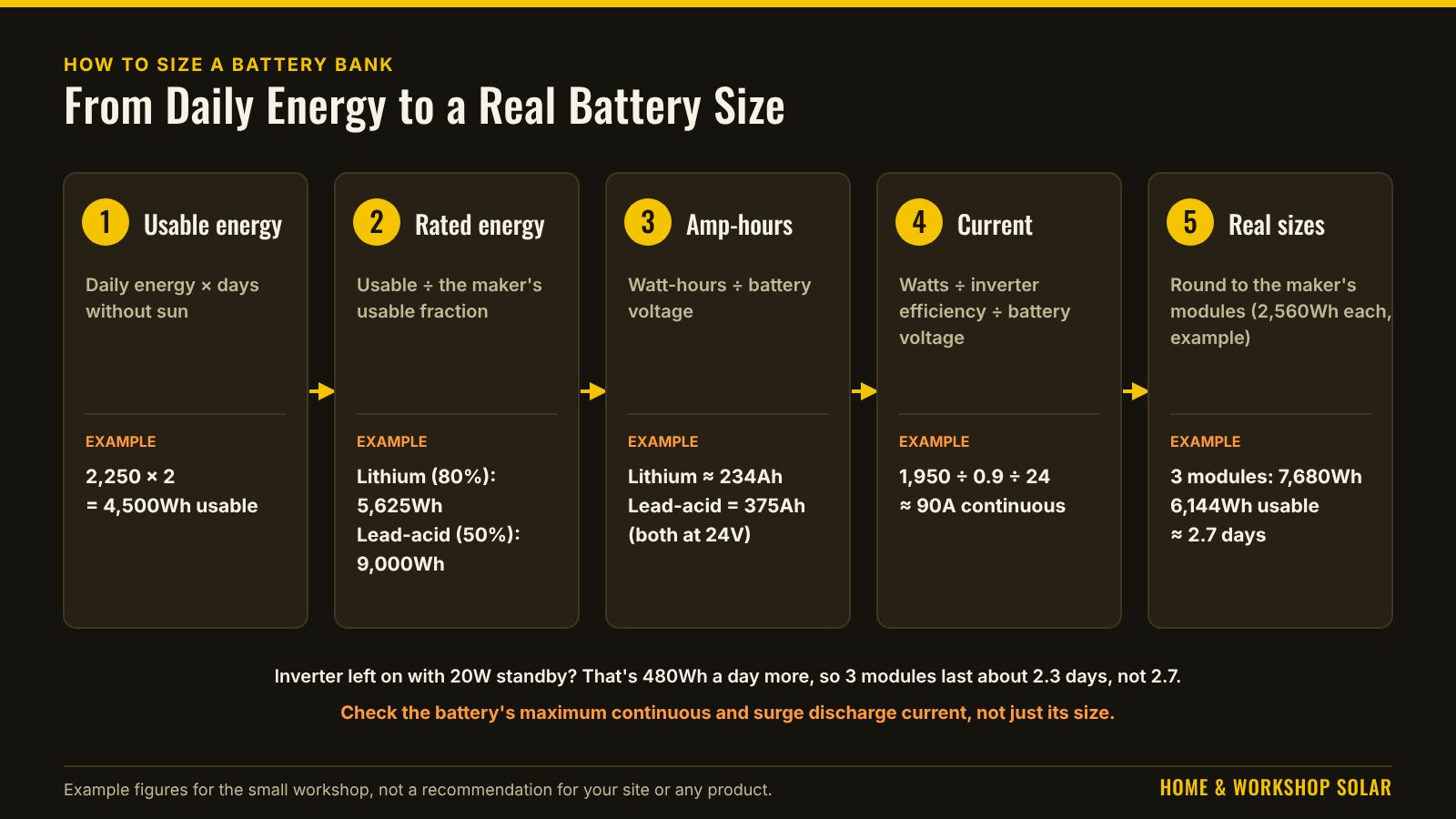
Step A: usable energy. 2,250 × 2 = 4,500Wh.
Step B: rated energy.
- Lithium: 4,500 ÷ 0.8 = 5,625Wh.
- Lead-acid: 4,500 ÷ 0.5 = 9,000Wh, which is 1.6 times the size.
Step C: amp-hours.
- Lithium: 5,625 ÷ 24 ≈ 234Ah, or 5,625 ÷ 25.6 ≈ 220Ah at the maker's 25.6V rating.
- Lead-acid: 9,000 ÷ 24 = 375Ah.
Step D: current. 1,950 ÷ 0.9 ÷ 24 ≈ 90A continuous, plus motor-start surges.
Step E: round to real sizes. 5,625 ÷ 2,560 ≈ 2.2, so:
- 2 modules give 4,096Wh usable, about 1.8 days.
- 3 modules give 6,144Wh usable, about 2.7 days.
Step F: standby. With the 20W standby added, daily use is 2,730Wh, and three modules last 6,144 ÷ 2,730 ≈ 2.3 days.
Result: about 5.6kWh rated is needed, and three example modules (about 7.7kWh) cover it with room to spare.
9. The ageing check
Batteries lose capacity over the years. A simple check is whether your choice still covers you when the battery holds less. Many makers treat a battery as worn out at a stated share of its original capacity. Take that figure from the data sheet; 80% is used here as an example.
- Workshop, planning for 80% capacity later: 5,625 ÷ 0.8 ≈ 7,031Wh rated needed. Three modules (7,680Wh) still cover it.
- At that point, three modules would give 7,680 × 0.8 × 0.8 ≈ 4,915Wh usable, about 2.2 days at 2,250Wh a day.
If your first choice only just covers you today, it won't in a few years. The cheapest time to add capacity is usually at the start.
10. Worked example 2: the small 12V shed (lithium vs AGM)
A hobby shed with LED lights, a radio, a tool battery charger and a laptop uses about 400Wh a day with margin. Its peak load is 190W, and it runs on 12V. Every figure is an example.
| Step | Lithium (80% usable) | AGM (50% usable) |
|---|---|---|
| Usable for 2 days | 400 × 2 = 800Wh | 800Wh |
| Rated needed | 800 ÷ 0.8 = 1,000Wh | 800 ÷ 0.5 = 1,600Wh |
| Amp-hours | 1,000 ÷ 12.8 ≈ 78Ah | 1,600 ÷ 12 ≈ 133Ah |
| Example choice | One 12.8V 100Ah (1,280Wh) | Two 12V 100Ah in parallel (2,400Wh) |
| Usable from that choice | 1,024Wh, about 2.6 days | 1,200Wh, about 3 days |
| Current at peak | 190 ÷ 0.9 ÷ 12 ≈ 18A, easy for either |
The standby lesson: add an 8W inverter standby (192Wh a day) and the lithium battery lasts 1,024 ÷ 592 ≈ 1.7 days, not 2.6. In a small system, the inverter's standby can matter more than any single appliance. Run 12V loads directly where you can, and switch the inverter off when it isn't needed.
11. Battery runs flat sooner than planned? Common causes
| What you notice | Likely cause | What to check |
|---|---|---|
| Flat by morning, every morning | Daily energy underestimated | Measure with a battery monitor; recheck fridge and standby loads |
| Fine in summer, flat in winter | Panels don't refill in winter; cold reduces capacity | Winter sun hours and refill check; battery location |
| Lasted well at first, now shorter | Normal ageing, or lead-acid left partly charged | Usable capacity today; charging profile |
| Shuts off under heavy load although charged | Current over the battery's or BMS's limit | Continuous and surge ratings against the load |
| Won't charge on cold mornings | Lithium low-temperature charge limit | Charge temperature range; heating or location |
| Shows full but runs out quickly | Battery monitor not set up, or state of charge out of step | Monitor settings; a full charge to resynchronise |
12. Common mistakes
- Comparing batteries by Ah across different voltages. Compare usable Wh.
- Using the rated capacity as usable, especially with lead-acid.
- Forgetting inverter standby.
- Sizing for energy but not current.
- No allowance for ageing.
- Mixing old and new batteries, or different models, in one bank.
- Putting a lithium battery somewhere it can't charge in winter.
- Buying the battery before checking it's compatible with the inverter-charger and controller, including charging settings and, for many lithium batteries, the communication link.
13. Frequently asked questions
How many days of battery do I need?
Two to three days is a common starting point for an off-grid shed or workshop with a backup charging source. Fewer days suits sunny places with a generator. More days gets expensive quickly.
Is lithium worth the extra cost?
For daily-cycled off-grid use, lithium's larger usable share and lighter weight often make it better value over its life. Lead-acid can suit occasional use on a tight budget. Compare the cost per usable kWh, not per Ah.
Can I add another battery later?
Only within the maker's rules. Many require the same model, and some don't allow new modules to be added to an old bank. If you expect to grow, plan for it now.
Do I need 24V or 48V for a big battery?
The system voltage follows your peak load, not the battery size. See 12V, 24V or 48V?.
Why does my battery deliver less in winter?
Cold reduces the energy a battery can deliver, and many lithium batteries limit charging in the cold. Check the data sheet's temperature ranges.
Should I size the battery or the panels first?
The battery first, from your daily energy and days of autonomy. Then size the panels to cover a winter day and refill the battery.
14. Before you buy: battery checklist
- ☐ Rated and usable energy from the exact model's current data sheet.
- ☐ Days of autonomy chosen, with a backup plan.
- ☐ Continuous and surge discharge cover the inverter's battery current.
- ☐ Maximum charge current covers all chargers together.
- ☐ The charging temperature range suits where it will live.
- ☐ Joining limits and module rules allow your layout and future growth.
- ☐ Still enough capacity after ageing.
- ☐ Compatible with the inverter-charger and controller: charging settings and communication.
- ☐ Panels can refill it after a cloudy run.
- ☐ Installation by qualified people, and a licensed electrician for any 240V AC work.
These are planning estimates only, not a system design, wiring specification or safety assessment. Real results depend on your loads, location, weather and the gear you choose.
Safety: in Australia, any work on 240V AC wiring, including connecting an inverter, battery or solar system to a home's switchboard or fixed wiring, must be done by a licensed electrician. Grid-connected systems also need approval from your electricity network. A battery bank can deliver a very large current into a short circuit, so follow the battery maker's installation instructions for protection and isolation.
Handy gear
These are examples to compare, not a recommendation for your home. Check any model's data sheet against this guide.
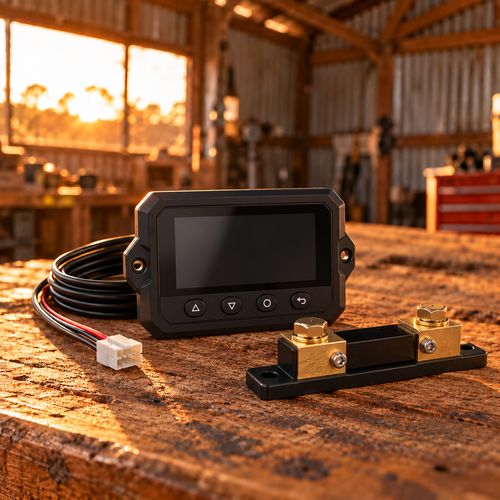
Battery monitor with shunt
Measures your real daily use before you size the bank.
Check Price on AmazonAs an Amazon Associate I earn from qualifying purchases. Prices and availability are shown on Amazon.
Related guides

How to Calculate Your Home or Workshop Power Needs
The first step for any solar system: list what you run, how long for, and turn it into the daily energy your system has to supply.
Read guide →
12V, 24V or 48V? Picking Your System Voltage
Why system voltage matters, how it changes the current and cable size, and which voltage suits a shed, workshop or home.
Read guide →