LiFePO4 Batteries Explained: Capacity, Voltage and Usable Energy
Read a lithium battery's ratings properly: nominal voltage, kWh, usable energy and the limits that matter.
Lithium iron phosphate (LiFePO4, or LFP) is now the usual choice for off-grid and backup batteries in sheds, workshops and homes. It lasts many cycles, lets you use most of its capacity, and is generally more stable than other lithium chemistries. But the ratings on the spec sheet can be confusing. Here's how to read them.
For how LiFePO4 compares with AGM, see Revival Academy 101's LiFePO4 vs AGM.
1. Why the voltages look odd: 12.8V, 25.6V, 51.2V
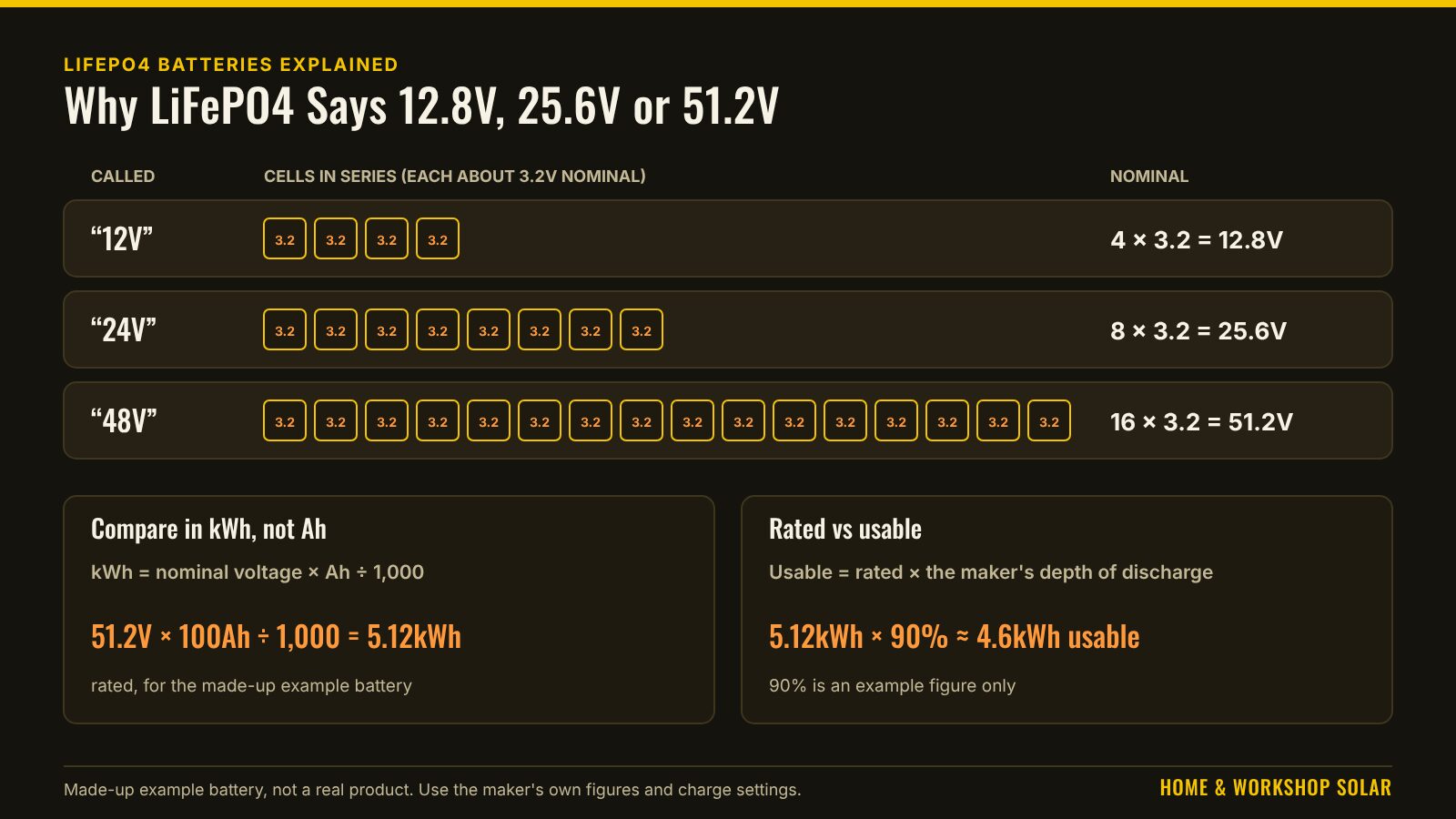
A LiFePO4 cell is about 3.2V nominal. Batteries are built from cells in series:
| Called | Cells in series | Nominal voltage |
|---|---|---|
| 12V | 4 | 4 × 3.2 = 12.8V |
| 24V | 8 | 8 × 3.2 = 25.6V |
| 48V | 16 | 16 × 3.2 = 51.2V |
So a "48V" lithium battery is usually labelled 51.2V. The real voltage moves above and below nominal as it charges and discharges. The battery's manual gives the actual charge and cut-off voltages, and your inverter-charger and solar controller must be set to them.
2. Ah vs kWh
- Amp-hours (Ah) only compare batteries of the same voltage.
- Kilowatt-hours (kWh) are the fair comparison: kWh = nominal voltage × Ah ÷ 1,000.
Example (made-up battery, not a real product): a 51.2V 100Ah battery holds 51.2 × 100 ÷ 1,000 = 5.12kWh rated.
Home batteries are often sold by kWh, sometimes with Ah in the small print. Use kWh to compare.
3. Rated vs usable energy
Rated energy is what the battery holds in total. Usable energy is what the maker lets you use. Makers state it as a usable kWh figure, a depth of discharge (DoD) percentage, or both.
Example: the made-up 5.12kWh battery with a stated 90% DoD (example figure): 5.12 × 0.9 ≈ 4.6kWh usable.
Some makers quote only usable energy on the front of the box. Check which figure you're reading, especially when comparing brands. Your inverter or BMS settings may also keep some reserve, which reduces it further.
4. Modules and stacking
Many home LiFePO4 batteries are modules that stack together for more capacity.
- Usually you add modules in parallel at the same voltage, so capacity grows.
- Makers set limits on how many modules can be joined, and often require the same model (and sometimes the same firmware or production batch).
- Adding a new module to an old bank years later may not be allowed. Check before you plan to grow the system.
The Battery Bank Series & Parallel Calculator at Wired For The Wild works out the layout for identical batteries.
4a. Comparing two batteries fairly
Two made-up batteries:
| Battery X | Battery Y | |
|---|---|---|
| Label | 12.8V 200Ah | 51.2V 100Ah |
| Rated energy | 12.8 × 200 = 2,560Wh | 51.2 × 100 = 5,120Wh |
| Stated depth of discharge (example) | 90% | 90% |
| Usable energy | ≈ 2,300Wh | ≈ 4,600Wh |
Battery X has twice the amp-hours, but Battery Y holds twice the energy. Comparing by Ah alone would get it exactly backwards.
4b. Stacking example: energy and current
Made-up example: three of Battery Y stacked in parallel on a 48V system.
- Rated: 3 × 5.12 = 15.36kWh. Usable at 90%: about 13.8kWh.
- Current for a 5,000W inverter load (90% efficiency, example): 5,000 ÷ 0.9 ÷ 51.2 ≈ 109A from the bank.
For comparison, the same 5,000W load would draw about 217A at 25.6V, and about 434A at 12.8V. This is why bigger home systems use 48V.
Check the maker's data sheet for how the bank's current limits apply when modules are joined. Some share the load evenly, and some limit the bank to less than the sum of the modules.
5. The limits on the spec sheet
| Limit | Why it matters |
|---|---|
| Max continuous discharge current or power | Must cover your inverter's full-load draw |
| Peak or surge discharge (and how long) | Must cover motor start-up surges |
| Max charge current | All chargers together must stay under it |
| Charge temperature range | Many LiFePO4 batteries won't charge below about 0°C without heating |
| Discharge and storage temperature ranges | Where the battery can live |
| Cycle life (with its conditions) | Only comparable at the same DoD, temperature and end-of-life capacity |
| Communication | Data link to the inverter, and its compatibility list |
| Warranty | Years, energy throughput limits and conditions |
5a. Reading cycle life and the warranty
- Cycle life only means something with its conditions: depth of discharge, temperature, and the end-of-life capacity (for example "to 70% of original"). Compare two batteries only under the same conditions.
- Warranties often run for a number of years or an amount of energy through the battery, whichever comes first. Heavy daily use can reach the energy limit before the years are up.
- Conditions may include a compatible inverter, installation inside the temperature range, an approved installer and registration.
Revival Academy 101's How to Read a Battery Data Sheet lesson works through both with examples.
6. The BMS
Every LiFePO4 battery should have a battery management system (BMS). It protects the cells from over-charge, over-discharge, over-current and temperature extremes, and balances them. In many home batteries it also talks to the inverter so charging follows the battery's needs.
A BMS is a protection layer, not a substitute for correct protection, isolation and installation.
6a. Where will it live? Temperature planning
| Location | Watch for | Questions to ask |
|---|---|---|
| Unheated shed or garage in a cold area | Winter mornings below the charging range | Does the model have heating or low-temperature charge protection? |
| Hot shed, roof space or west-facing wall | Summer heat above the operating or storage range | Can it be moved somewhere shaded and ventilated? |
| Outdoors | Sun, rain and dust | Is it rated for outdoor use (IP rating), and does it need a shade cover? |
| Indoors, in living areas | The maker's and installer's location rules | Where does the installation manual allow it? |
The charging range is usually the narrowest. A battery that can't charge on a winter morning loses the morning's solar.
6b. LiFePO4 and other lithium home batteries
Some home batteries use other lithium chemistries, such as nickel-manganese-cobalt (NMC). As a broad, general comparison:
- LiFePO4 is generally regarded as more thermally stable, with long cycle life, but it's heavier for the same energy.
- Other lithium chemistries can pack more energy into less weight and space, with different safety and lifetime trade-offs.
Whichever chemistry it is, the data sheet's limits, the installation manual and a qualified installer decide how it's used.
7. Practical storage
- Keep the battery within its temperature range, out of direct sun, with the clearances and ventilation the manual asks for.
- For a battery left unused for a long time, follow the maker's storage advice on state of charge, and check it periodically.
- Keep firmware up to date if the maker recommends it.
8. Quick summary
- 12.8V, 25.6V and 51.2V are the nominal voltages of 4, 8 and 16 cells.
- Compare in kWh, not Ah.
- Check usable energy, not just rated energy.
- Modules stack, within the maker's rules.
- Read the current, temperature and cycle limits, and match every charger and inverter to them.
9. Buyer's checklist
- ☐ The exact model's current data sheet, from the maker.
- ☐ Nominal voltage matches the system (12.8V, 25.6V or 51.2V).
- ☐ Usable kWh covers your plan (see How to Size a Battery Bank).
- ☐ Continuous and surge discharge cover the inverter.
- ☐ Maximum charge current covers all your chargers together.
- ☐ Charging temperature range suits the location, or the model has heating.
- ☐ Stacking rules allow your layout and future growth.
- ☐ Communication works with your inverter (check the compatibility list).
- ☐ Warranty years, throughput limit and conditions, and a local Australian distributor.
- ☐ Installed by qualified people, with a licensed electrician for any 240V AC work.
10. Common mistakes
- Comparing by Ah across voltages.
- Reading rated kWh as usable kWh.
- Ignoring the charging temperature range.
- Assuming any module can be added later.
- Leaving the charger or controller on a lead-acid profile.
- Trusting a seller's listing instead of the maker's data sheet.
11. Frequently asked questions
Why is my "12V" lithium battery labelled 12.8V?
Four LiFePO4 cells at about 3.2V each make 12.8V nominal. It's still a "12V" battery for system purposes.
How much of a LiFePO4 battery can I use?
Most of it, but the maker's stated depth of discharge or usable kWh is the figure to plan with.
Can I charge a LiFePO4 battery below 0°C?
Many can't, unless they have heating or low-temperature protection. Check the data sheet's charging range.
Can I add a module to my battery in a few years?
Only if the maker allows it. Many require the same model, and sometimes the same firmware.
Is LiFePO4 safe indoors?
It depends on the model's installation manual and the relevant rules for your location. Ask a qualified installer.
Safety: a battery bank can deliver a very large current into a short circuit. Follow the battery maker's installation instructions for protection and isolation. In Australia, any work on 240V AC wiring, including connecting an inverter, battery or solar system to a home's switchboard or fixed wiring, must be done by a licensed electrician. Grid-connected systems also need approval from your electricity network.
Handy gear
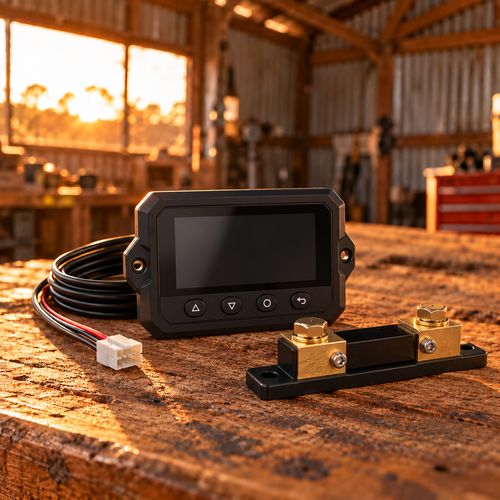
These are examples to compare, not a recommendation for your home. Check any model's data sheet against this guide.
As an Amazon Associate I earn from qualifying purchases. Prices and availability are shown on Amazon.
Related guides
Pure Sine vs Modified Sine Inverters
How the two types of inverter differ, which appliances and tools need pure sine, and what to check before you buy.
Read guide →
How to Calculate Your Home or Workshop Power Needs
The first step for any solar system: list what you run, how long for, and turn it into the daily energy your system has to supply.
Read guide →