Running a Compressor or Welder Off Solar
Big tools need big inverters. Here is how to check before you buy.
Compressors and welders are among the hardest loads for an off-grid system. They pull a big surge to start and lots of power while running.
1. Compressors
- Motor compressors can draw several times their running watts for a moment at start-up.
- Check the inverter's surge rating and how long it can hold it.
- Bleed the tank pressure before starting, or use a compressor with an unloader valve, to make starting easier.
2. Welders
- Inverter welders are much easier on a power supply than old transformer welders.
- Check the welder's input current or kVA at the setting you'll use.
- Welding at high amps can pull more than a 15A circuit can supply.
3. Battery side
A 3,000W load on a 24V battery pulls around 140A. Check the battery's maximum discharge current and the DC cables and fuses.
4. Duty cycle and energy
Work out how many minutes per hour the tool really runs, and how much energy that takes from the battery. Use the Compressor Energy Calculator.
5. Tips
- Size the inverter for surge, not just running watts.
- Pure sine inverters suit motors best.
- Consider a generator for long heavy jobs.
6. Quick summary
- Check surge and running watts.
- Check battery current and cables.
- Use a generator for heavy, long jobs.
In Australia, any work on 240V AC wiring, including connecting an inverter, battery or solar system to a switchboard or fixed wiring, must be done by a licensed electrician.
Related guides
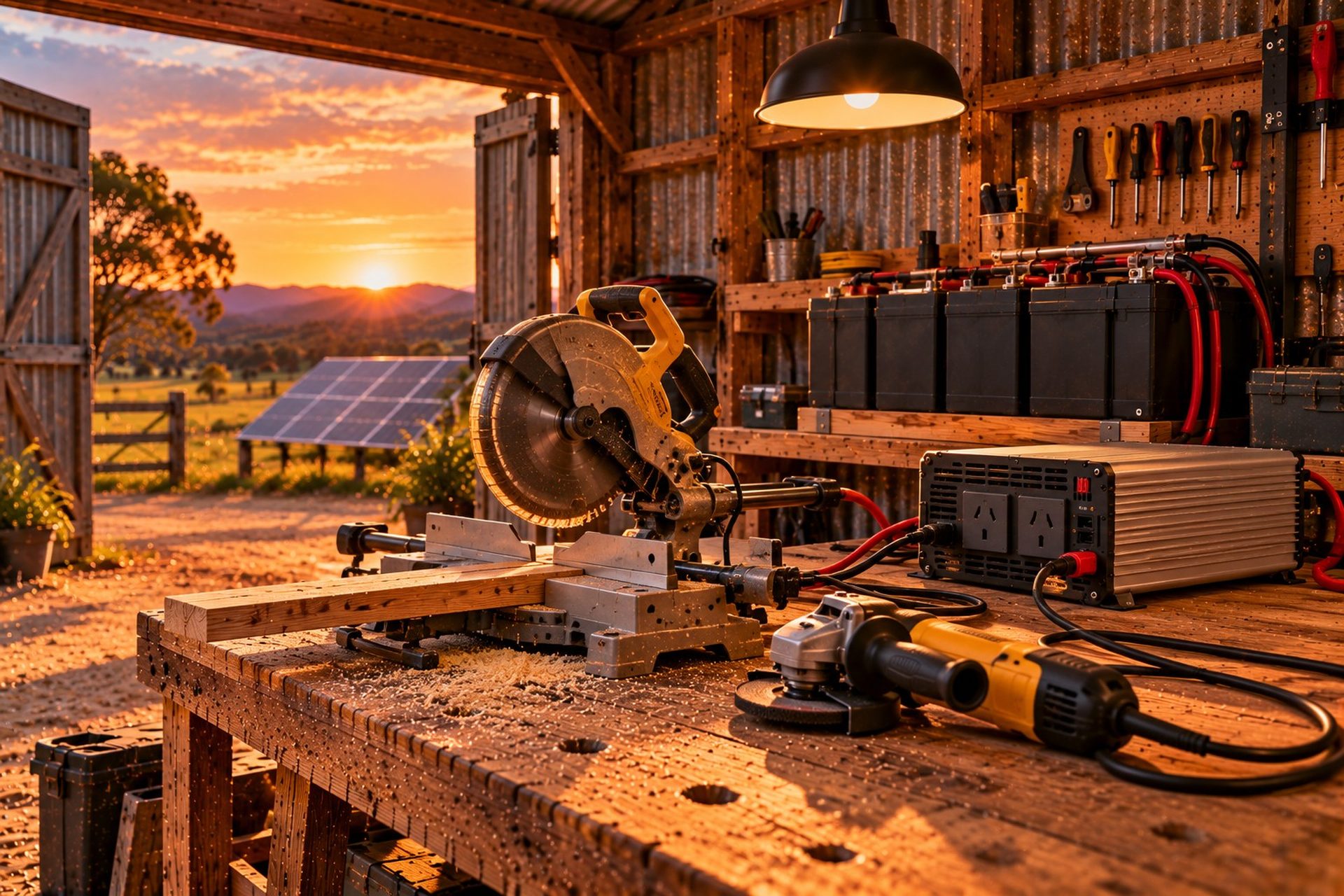
Running Power Tools Off Solar
How much inverter and battery you need to run workshop tools, why motors need a surge allowance, and what runs easily.
Read guide →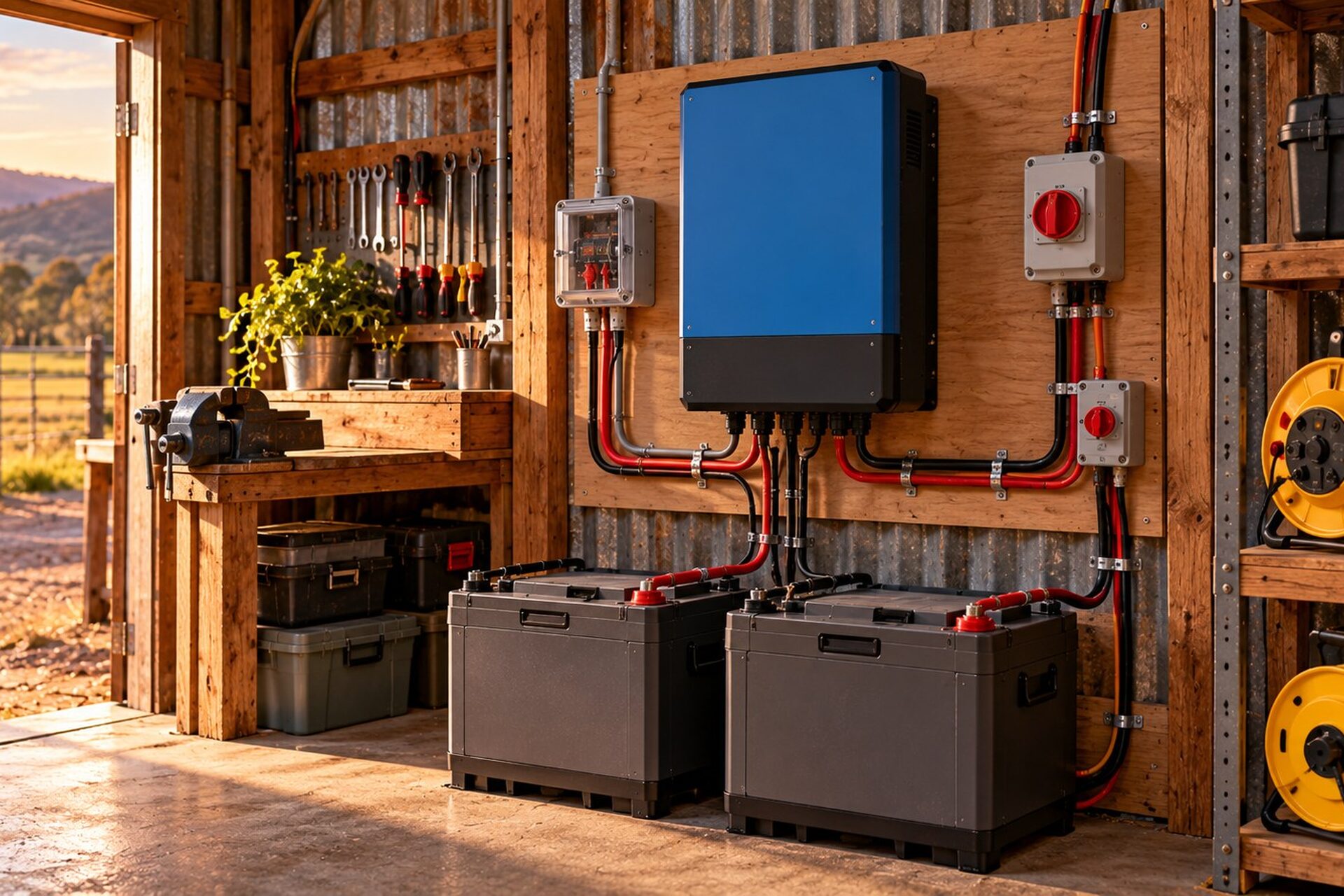
How to Choose an Off-Grid Inverter (Sizing, Surge and Inverter-Chargers)
Choosing an inverter for an off-grid shed, workshop or home: continuous and surge power with worked examples, battery voltage, inverter-chargers, idle draw, compatibility and warranty.
Read guide →
Inverter Size Calculator for Power Tools
Free calculator: list the tools and appliances you run at once, allow for start-up surge, and find the inverter size and battery current for your shed.
Open calculator →