Choosing Between a Home Battery and a Portable Power Station
Two very different products that both store energy. Here's which job each one does well.
Home batteries and portable power stations both store energy and both can keep things running when the power goes out. That's where the similarity ends. They're different product categories, built for different jobs, and one isn't simply a cheaper or dearer version of the other.
1. What each one is
A home battery is part of a fixed solar or backup system. It's installed on a wall or floor, connected to an inverter (or has one built in), and wired into the home's switchboard by a licensed electrician. It works in the background, storing solar energy for the evening and, if the system has a backup function, running chosen circuits in a blackout.
A portable power station is a self-contained box with a battery, inverter, charger and outlets. You plug appliances straight into it, and charge it from a power point, solar panels or a vehicle. Nothing is installed.
2. Side by side
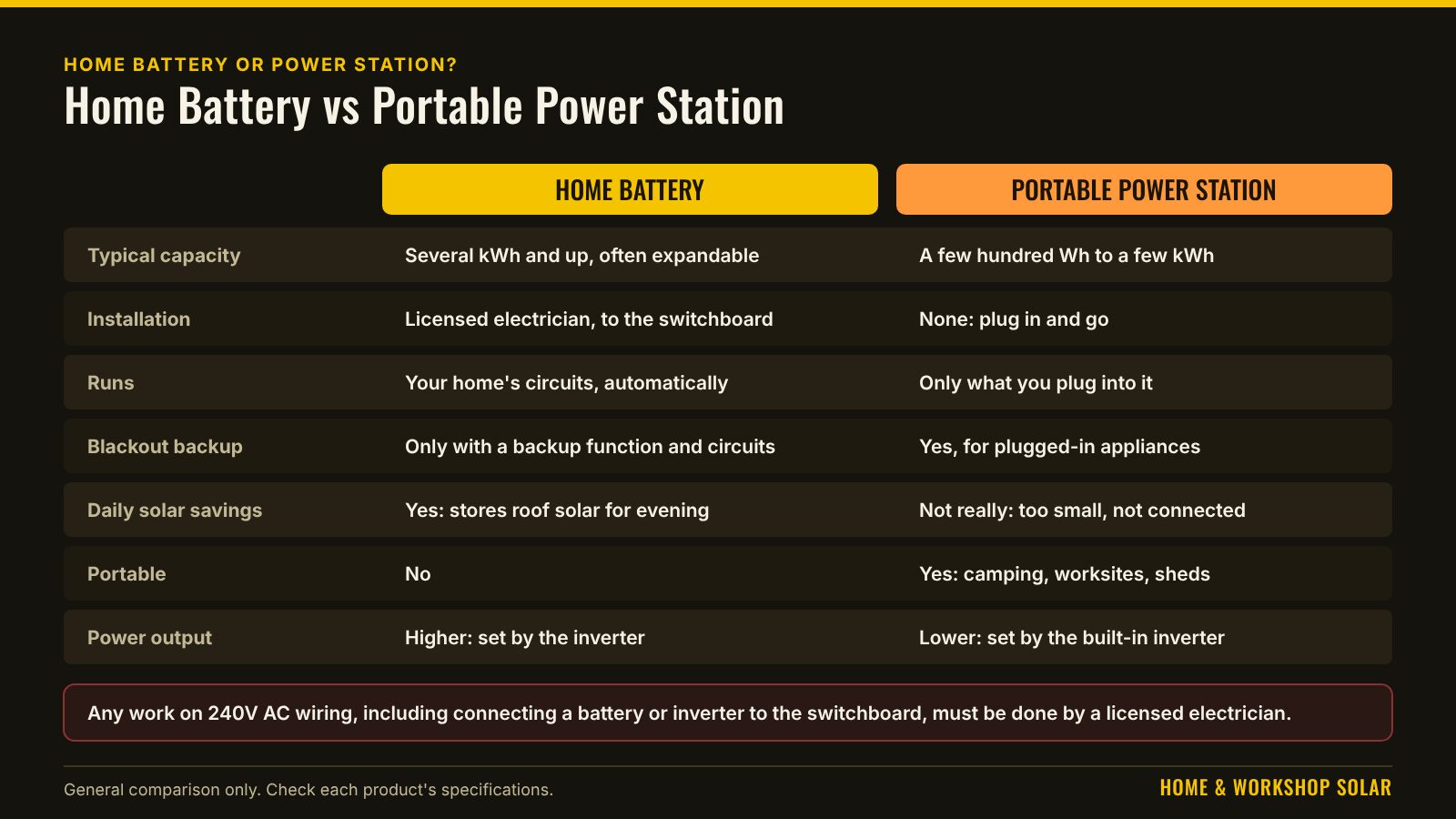
| Home battery | Portable power station | |
|---|---|---|
| Typical capacity | Several kWh and up, often expandable | A few hundred Wh to a few kWh |
| Installation | Licensed electrician; connected to the switchboard | None; plug in and go |
| Runs | Your home's circuits, automatically | Only what you plug into it |
| Blackout backup | Only if the system has a backup function and backup circuits | Yes, for plugged-in appliances |
| Daily solar savings | Yes, stores roof solar for evening use | Not really; too small and not connected |
| Portable | No | Yes: camping, worksites, sheds |
| Power output | Higher; set by the inverter | Lower; set by the built-in inverter |
| Approvals | Grid-connected systems need network approval | None for plug-in use |
3. When a home battery makes sense
- You already have, or are getting, rooftop solar and want to use more of it in the evening.
- You want blackout backup for whole circuits, such as the fridge, lights and power points, without plugging things in.
- You want an off-grid shed, workshop or home with a proper system.
- You're prepared for the installation cost and approvals.
See How to Size a Battery Bank for an Off-Grid System and Solar Battery Backup: What Can You Run During a Blackout?.
4. When a portable power station makes sense
- You want a simple backup for the fridge, lights, modem and phones in a blackout, with no installation.
- You rent, or can't install a fixed system.
- You also want power for camping, a worksite or a shed without power.
- Your needs are small, or occasional.
Wired For The Wild covers power stations in detail in Portable Power Stations, and compares them with DIY battery boxes in Power Station vs DIY Battery Box.
4a. Sizing a power station for blackout essentials
Example figures (from the blackout guide's example loads):
- The loads: fridge about 820Wh a day, modem and router 360Wh, lights 300Wh. That's 1,480Wh a day at the plug.
- Inverter losses: through the station's inverter at about 85% efficiency, that's 1,480 ÷ 0.85 ≈ 1,740Wh a day from its battery.
- The size needed: to cover a 12-hour outage overnight, you'd want about 870Wh usable, plus some margin.
Then check the power, not just the energy:
- The station's continuous output must cover everything running at once.
- Its surge rating must cover the fridge compressor starting.
- The maker's spec sheet gives both.
4b. Recharging during a long outage
A power station can be recharged from a folding solar panel during a long blackout.
Example (made-up figures): a 200W panel with 3 winter sun hours and a 30% loss allowance gives about 200 × 3 ÷ 1.3 ≈ 460Wh a day. That's about a quarter of the essentials' daily use, so it stretches the runtime but doesn't replace it.
Check the station's maximum solar input (volts and watts) before you buy a panel. Wired For The Wild's Power Station Runtime Calculator works through runtime.
5. They aren't interchangeable
- A power station can't replace a home battery's job. It's too small to store a day's rooftop solar for a typical home, and it doesn't connect to your switchboard.
- A home battery isn't portable, and without a backup function it may not run anything in a blackout.
- Never connect a power station to your home's wiring by plugging it into a power point or using a home-made lead. It can feed power back into the wiring and kill someone. A connection to the home's wiring needs an approved inlet and changeover switch installed by a licensed electrician, and the power station must be suitable for that use according to its maker.
6. Compare the cost properly
Compare cost per usable watt-hour, not the sticker price. Divide the price by the usable energy.
Worked example (made-up prices and capacities, not real products):
- Power station: $1,500 for 1,000Wh usable = $1,500 ÷ 1,000 = $1.50 per Wh
- Home battery, installed: $12,000 for 10,000Wh usable = $12,000 ÷ 10,000 = $1.20 per Wh
Cost per Wh is only half the story. The home battery also needs a suitable inverter and solar to earn its keep, and it cycles every day. The power station may sit unused for months. Think about what you'll actually use each one for.
6a. What to check on each spec sheet
Home battery:
- Usable kWh, not just rated.
- Backup function, and the backup output power.
- Which circuits will be backed up (decided with the installer).
- Compatibility with your inverter, or a built-in inverter.
- Warranty years, energy-throughput limit and conditions.
- Australian distributor and approvals.
Portable power station:
- Usable Wh, and the battery chemistry.
- Continuous and surge output.
- Number and type of outlets.
- Charging inputs: mains, solar (maximum volts and watts) and vehicle.
- Pass-through or "UPS" function, if you want it to switch over automatically (check how fast).
- Weight, warranty and local support.
7. Can you have both?
Yes, and many people do. A home battery runs the house day to day, and a power station goes camping, to the worksite, or into the room that isn't on a backup circuit.
7a. Three households
| Household | Likely fit | Why |
|---|---|---|
| Renting a unit, occasional blackouts | Power station | No installation; moves with you |
| Family home with rooftop solar, higher evening bills | Home battery, with a backup function if blackouts matter | Stores solar every day; backs up circuits automatically |
| Off-grid weekender shed | A small fixed system, or a power station plus a panel for light use | Depends on the loads. See How to Design an Off-Grid Solar System |
8. Quick decision guide
- Want lower power bills from rooftop solar? Home battery.
- Want whole-circuit blackout backup without plugging things in? Home battery with a backup function.
- Want a simple blackout kit for a few essentials? Power station.
- Renting, or need it to travel? Power station.
9. Common mistakes
- Assuming a home battery gives blackout backup without a backup function.
- Comparing sticker prices instead of cost per usable Wh.
- Buying a power station for its Wh and forgetting its output and surge limits.
- Plugging a power station into a power point to feed the house.
- Expecting a small solar panel to keep a power station full in winter.
10. Frequently asked questions
Can a portable power station run my fridge in a blackout?
Usually yes, if its continuous and surge output cover the fridge. How long it lasts depends on its usable Wh and the fridge's daily use.
Will a home battery save me money?
It can, by storing rooftop solar for the evening. How much depends on your use, your tariffs and the battery's cost and life. Get a proper quote and compare the cost per usable Wh.
Can I connect a power station to my switchboard?
Only through an approved inlet and changeover switch installed by a licensed electrician. Never use a power point or a home-made lead.
Is a power station enough for a shed?
For light, occasional use, often yes. For daily power tools, a fixed off-grid system usually suits better.
Can I have both?
Yes. Many people use a home battery for the house and a power station for camping, worksites and the odd room that isn't backed up.
Safety: in Australia, any work on 240V AC wiring, including connecting an inverter, battery or solar system to a home's switchboard or fixed wiring, must be done by a licensed electrician. Grid-connected systems also need approval from your electricity network.
Handy gear
These are examples to compare, not a recommendation for your home. Check any model's data sheet against this guide.
BLUETTI Elite 100 V2
1,024Wh LiFePO4 power station with 1,800W AC output and UPS-style switchover (maker's figures).
See it at BLUETTI AustraliaBLUETTI Elite 200 V2
2,073.6Wh LiFePO4 power station with 2,600W AC output, for longer outages (maker's figures).
See it at BLUETTI Australia
As an Amazon Associate I earn from qualifying purchases. I also earn commission from BLUETTI through the Awin network, at no extra cost to you. Prices and availability are shown on each seller's site.
Related guides
Pure Sine vs Modified Sine Inverters
How the two types of inverter differ, which appliances and tools need pure sine, and what to check before you buy.
Read guide →
How to Calculate Your Home or Workshop Power Needs
The first step for any solar system: list what you run, how long for, and turn it into the daily energy your system has to supply.
Read guide →