Small Wind Turbines: Is Wind Power Right for You?
When small wind works, why the site matters most, and what to check before you buy.
The quick answer
For most homes, and for most caravans and campers, solar is the simpler place to start. The Australian Government's YourHome guide says wind generators are not suitable for most homes, and that household wind systems cost much more than solar.
Small wind can still be worth a look on the right site: open rural, coastal or elevated land with strong, steady wind, where it can work alongside solar. The site decides almost everything, so get it assessed properly before you spend money on a turbine.
When small wind can make sense
- Rural and off-grid properties on open, elevated or coastal land, with no trees or buildings blocking the wind. YourHome says turbines generate the most energy in these spots.
- Where you need power when solar is weak. Wind can blow at night and in winter or stormy weather, when solar output drops. Whether it does at your place is something only measuring will tell you.
- Where you have room for a tower, its footings and, for some designs, guy wires, and space to lower it for servicing.
Usually not a good fit:
- Towns and suburbs. YourHome says urban areas are not suitable for wind turbines and that most jurisdictions don't allow them there. It also warns to be wary of anyone claiming a product suits urban or turbulent locations.
- Sheltered sites among trees, buildings or hills.
- On or beside a house or shed roof. The NSW small wind turbine guide notes that roof edges and spots next to buildings have high turbulence.
Sheds and workshops: the same rules apply. It's the site that matters, not the building. A shed on an open rise may suit; one tucked behind a house and trees usually won't.
Caravans, campers and 4WDs: small 12V and 24V turbines are made for boats and off-grid sites. Marlec's Rutland 1200 manual, for example, covers on-board and land-based installs, and says to mount it at least 6 metres above ground on land, following its siting guidelines. Most campsites are sheltered, and a short pole beside a van sits in disturbed air close to the van and trees, so expect much less than a turbine's rated output. For most trips a solar blanket or panel is simpler, quieter and easier to carry. If you do take a turbine, check the rules where you're staying first.
Why the site matters most
The energy in the wind rises very steeply with wind speed. The NSW guide explains that power rises with the cube of wind speed, so a site that's only a little windier can produce a lot more energy, and a slightly sheltered one a lot less.
- Strong, smooth wind. YourHome says you need a location with smooth (not turbulent), reasonably strong winds, of more than 4 metres per second.
- Height. Winds usually get faster and smoother with height. YourHome says a typical tower for a home system is 15 to 20 metres tall. Taller towers cost more and can be harder to get approved.
- Obstacles. Trees, buildings and hills create turbulence that reaches downwind and above them. Turbulence cuts output, and turbine makers such as Primus warn that it causes fatigue damage and shortens a turbine's life.
- Follow the maker's siting guidance. Each manufacturer sets its own minimum height and distance from obstacles for its turbines.
Measure before you buy. Bureau of Meteorology data and wind maps are a useful starting point, but the NSW guide explains they're too coarse to judge a particular site. It recommends monitoring wind at your site for several months. A few spot readings on a windy afternoon won't tell you the yearly average.
Wind and solar work best together
Wind rarely replaces solar. On a suitable site it can complement it, because the two often produce at different times: solar by day and in summer, wind at any hour when it blows. The NSW guide lists the potential to complement solar as one of wind's benefits.
- Some controllers accept both. Marlec's Rutland 1200, for example, comes with a hybrid controller that takes wind and solar.
- Check how charging sources work together. Primus notes that other charging sources can interfere with its turbine's regulation, and that adding sources may need a larger battery bank. Ask the makers of your turbine and other chargers how they should be combined.
- Work out your needs first. Our Battery Size Calculator estimates your daily use, and the Solar & Charging Check compares it with your solar and DC-DC charging. That shows how much of a gap wind would need to fill.
The main parts of a small wind system
- The turbine: the blades (rotor), a generator, and usually a tail that keeps it facing the wind.
- The tower and footings: guyed, freestanding (monopole) or lattice towers, some of which tilt down for servicing. YourHome notes that a tall tower needs sufficient footings, and that these can be expensive.
- A controller or regulator: it manages charging so the battery isn't overcharged. Some small turbines have one built in that slows or stops the blades when the battery is full.
- Diversion (dump) load: on many systems, surplus power is sent to a resistive load to control the turbine and protect the battery. The controller must suit the turbine. Primus, for example, says external controllers for its AIR turbines must be a diversion type.
- Stop or brake switch and overspeed protection: a way to stop the turbine, plus protection in very high winds. The NSW guide describes furling, braking and electronic control as common methods.
- A battery bank: stores the energy for off-grid use. Lithium batteries need a charge profile set to the battery maker's voltages. See Battery Management and Lithium vs AGM Battery for Camping.
- An inverter if you want 240V AC power. Our Charger & Inverter Sizing Calculator helps size one.
- Fusing, cable and isolation as specified in the turbine manual for that model.
Never let a turbine run with nothing connected. Marlec says never let its turbine generate without a battery connected, and Primus warns that spinning freely without a load causes rapid wear. The NSW guide explains that unloaded turbines can overspeed. Follow your manual's procedure for stopping and disconnecting the turbine.
Practical limits: cost, output, noise and storms
Cost. YourHome says household wind systems are much more expensive than solar PV systems, and the tower and footings add a lot. We don't quote prices or payback times, because they depend on your site, the equipment and installation. Get written quotes.
Realistic output.
- A turbine's rated power is quoted at a fairly high wind speed. Primus rates its AIR turbines at 12.5 m/s, for example. Most of the time the wind is lighter, so output is well below the rating.
- The NSW guide notes that manufacturers' power curves are often not independently verified.
- Ask for a written estimate of annual energy output (kWh) for your site. Victoria's Department of Education says its schools' supply contracts should include one.
Noise. It varies by model and site. The NSW guide says louder turbines need more distance from neighbours, and that certified sound data helps with approvals. Ask for it, and talk to your neighbours early.
Maintenance. Turbines are exposed, moving machinery and need regular checks. As one example, Primus' manual sets inspections after the first month and then every six months, and replacing the blades every five years for its AIR turbines. Your turbine's schedule may differ. A tower that tilts down lets work be done at ground level. The NSW guide says other towers need a crane, cherry picker or climbing, done by qualified people.
Storms. High winds are the hardest test. Check what overspeed or storm protection the turbine has, and what the manual says to do before severe weather. For long shutdowns, Primus advises lowering the turbine or securing the blades. Marlec's warranty excludes lightning and hurricane-force wind damage, so check yours.
Support. Buy from an established maker that will still supply parts and service in years to come. Victoria's Department of Education gives its schools the same advice.
Tower, mounting and electrical safety
- Rotating blades are a serious hazard. Both Primus and Marlec say to install the turbine where no one can reach the blades, and to stop the blades or lower the tower before any work.
- Never climb a tower or approach a turbine in high wind, and follow the manufacturer's shutdown steps first.
- Towers and footings must suit the site. Primus says they must be designed for the specific soil and wind conditions. Have them designed by a qualified engineer and built by appropriately licensed trades. The NSW guide lists AS 1170.2 (wind loading) among the standards relevant to towers; we haven't reviewed that standard, so we don't summarise it here.
- Don't mount a turbine on a house, shed or caravan structure without advice from an engineer and the turbine maker. Vibration and wind loads go into the structure.
- 240V work needs a licensed electrician. That includes inverters wired into a building, switchboards and any grid connection. In Victoria, for example, Energy Safe Victoria says you must engage a registered electrical contractor, and the electrician must give you a Certificate of Electrical Safety. Rules vary between states.
- Grid connection needs approval from your electricity distributor before anything is connected.
- Follow the instructions from your turbine, controller, battery and inverter makers.
For more on 12V and 240V safety, see the safety section of our 12V system guide.
Planning approvals and local rules
Approval rules for small wind turbines vary between states, councils and zones, and they change over time. We can't give one answer that applies everywhere.
- Check with your local council first. Victoria's Department of Education tells its schools to check whether a building permit is needed and that the system complies with the planning scheme. Home owners should ask the same questions.
- Expect towns to be difficult. YourHome says most jurisdictions don't allow turbines in urban areas.
- NSW example: the NSW guide (2011) explains that state planning rules set when a small turbine is exempt, can be approved as complying development, or needs a development application, based on things like zone, height, capacity and distance from neighbours. These rules have changed since that guide was written, so check the current rules with your council.
- Talk to your neighbours early, especially about noise and the view.
- Small-scale certificates: the Clean Energy Regulator says a wind system can earn small-scale technology certificates (STCs) if its capacity is less than 10 kW and its total annual output is less than 25 MWh. Ask your installer how this applies to you.
- Camping: check campground, park or property rules before putting up a turbine.
Before you buy: a checklist
- Has the wind at your site been measured, ideally for several months?
- Is the turbine high enough and far enough from obstacles, according to the maker's siting guidance?
- Do you have a written estimate of annual energy output for your site?
- Is the power curve independently tested or certified?
- Does the controller suit both the turbine and your battery type?
- Can the tower be lowered, or how will maintenance be done safely?
- What storm and overspeed protection does it have?
- Do you have noise data, and have you talked to your neighbours?
- Have you checked council approval, building permit and grid connection requirements?
- Who will design the tower and footings, and who will do the electrical work?
- What warranty and long-term support does the maker offer?
Quick FAQ
Is wind better than solar? For most homes and campers, no. YourHome says wind isn't suitable for most homes and costs much more than solar. On a windy, open site it can be a useful partner to solar.
Can I put a wind turbine on my caravan? Small turbines exist, but campsites are often sheltered and a short pole gives the turbine poor, turbulent wind, so output is usually low. Solar is simpler for most trips. Check campground rules if you want to try one.
Do I need council approval? It depends on your state, council and zone. Check with your council before you buy.
Can I install a turbine myself? Towers, footings and mounting must be designed for the site and installed safely, and 240V work must be done by a licensed electrician. Follow the turbine maker's instructions, and use qualified professionals for structural and electrical work.
How much power will a small turbine make? It depends almost entirely on the wind at your site. Measure it, and get a written estimate for your site rather than relying on the rated output.
Next steps
- Start with your daily use: Battery Size Calculator.
- See what solar would give you: Caravan & 4WD Solar Panels and the Solar & Charging Check.
- Need back-up power? How to Charge a 12V Battery From a Generator.
- At home or a powered site: Grid Supply.
- Compare all your options on the Generation page.
Sources
Facts in this guide are based on these sources. Figures from manufacturers are examples for their own products only.
- YourHome (Australian Government): Renewable energy
- Clean Energy Regulator: Small-scale wind and hydro systems
- NSW Office of Environment and Heritage: NSW Small Wind Turbine Consumer Guide (2011)
- Victorian Department of Education: Wind energy
- Energy Safe Victoria: Electrical workers
- Marlec: Rutland 1200 installation manual
- Primus Wind Power: AIR owner's manual (dealer-hosted copy)
Related guides
Micro-Hydro Power: Is Your Creek Enough?
How micro-hydro works, why head and year-round flow decide everything, and what to check before you start.
Read guide →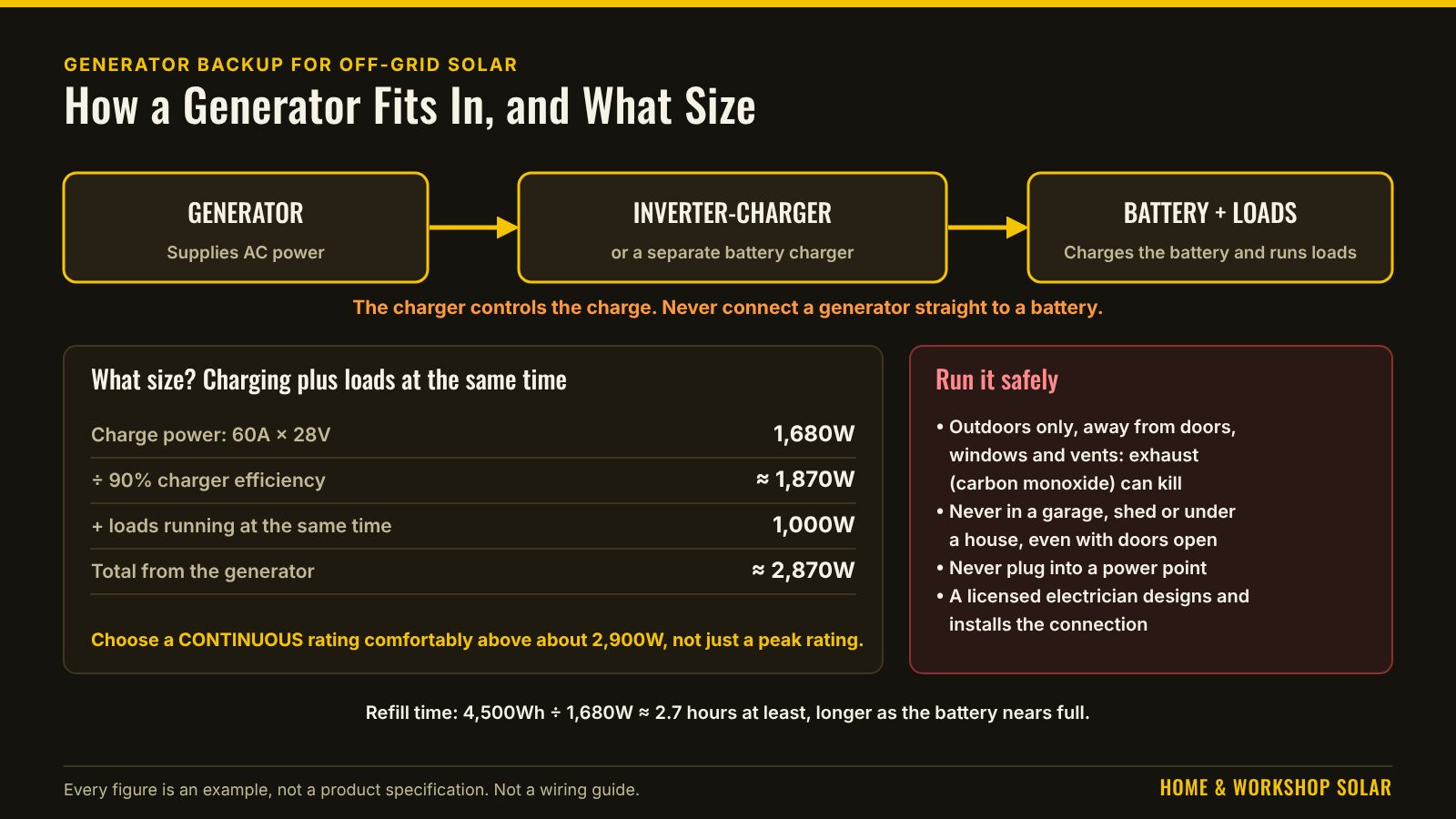
Generator Backup for an Off-Grid Solar System
When a backup generator makes sense for off-grid solar, how it charges the battery, what size to look at, and the compatibility checks before you buy.
Read guide →